The Lateran Council ends by condemning the Council of Hieria and anathematizing its iconoclastic rulings.
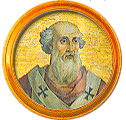
Lateran Council (769)
The Lateran Council of 769 was a synod held in the Basilica of St. John Lateran to rectify perceived abuses in the papal electoral process which had led to the elevation of the antipopes Constantine II and Philip. It also condemned the rulings of the Council of Hieria. It is perhaps the most important Roman council held during the 8th century.
Council of Hieria
The Council of Hieria was a Christian council of 754 which viewed itself as ecumenical, but was later rejected by the Second Council of Nicaea (787) and by Roman Catholic and Eastern Orthodox churches, since none of the five major patriarchs participated. However, it is preferred over Second Nicaea by some Protestants. The council was significant in the controversy of Byzantine iconoclasm, condemning the veneration and production of religious icons as idolatrous and pagan, reflecting Byzantine Emperor Constantine V's iconoclasm. This council declared itself the 'Seventh Ecumenical Council', as did the Second Council of Nicaea.
Anathema
The word anathema has two main meanings. One is to describe that something or someone is being hated or avoided. The other refers to a formal excommunication by a church. These meanings come from the New Testament, where an anathema was a person or thing cursed or condemned by God. In the Old Testament, an anathema was something or someone cursed and separated from God because of sin. These represent two types of settings, one for devotion, the other for destruction.
Iconoclasm
Iconoclasm is the social belief in the importance of the destruction of icons and other images or monuments, most frequently for religious or political reasons. People who engage in or support iconoclasm are called iconoclasts, a term that has come to be figuratively applied to any individual who challenges "cherished beliefs or venerated institutions on the grounds that they are erroneous or pernicious."