Torrential rains caused the Mississippi River to break out of its levee system in at least 145 places, resulting in the worst flooding in the history of the United States.
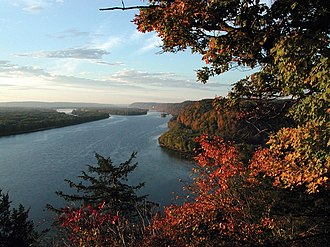
Mississippi River
The Mississippi River is the primary river of the largest drainage basin in the United States. It is the second-longest river in the United States, behind only the Missouri. From its traditional source of Lake Itasca in northern Minnesota, it flows generally south for 2,340 mi (3,770 km) to the Mississippi River Delta in the Gulf of Mexico. With its many tributaries, the Mississippi's watershed drains all or parts of 32 U.S. states and two Canadian provinces between the Rocky and Appalachian mountains. The river either borders or passes through the states of Minnesota, Wisconsin, Iowa, Illinois, Missouri, Kentucky, Tennessee, Arkansas, Mississippi, and Louisiana. The main stem is entirely within the United States; the total drainage basin is 1,151,000 sq mi (2,980,000 km2), of which only about one percent is in Canada. The Mississippi ranks as the world's tenth-largest river by discharge flow, and the largest in North America.
Great Mississippi Flood of 1927
The Great Mississippi Flood of 1927 was the most destructive river flood in the history of the United States, with 27,000 square miles (70,000 km2) inundated in depths of up to 30 feet (9 m) over the course of several months in early 1927. The period cost of the damage has been estimated to be between $246 million and $1 billion, which ranges from $3.5–$14.1 billion in 2023 dollars.
Levee
A levee, dike, dyke, embankment, floodbank, or stop bank is an elevated ridge, natural or artificial, alongside the banks of a river, often intended to protect against flooding of the area adjoining the river. It is usually earthen and often runs parallel to the course of a river in its floodplain or along low-lying coastlines.
History of the United States
The land which became the United States was inhabited by Native Americans for tens of thousands of years; their descendants include but may not be limited to 574 federally recognized tribes. The history of the present-day United States began in 1607 with the establishment of Jamestown in modern-day Virginia by settlers who arrived from the Kingdom of England. In the late 15th century, European colonization began and largely decimated Indigenous societies through wars and epidemics. By the 1760s, the Thirteen Colonies, then part of British America and the Kingdom of Great Britain, were established. The Southern Colonies built an agricultural system on slave labor and enslaving millions from Africa. After the British victory over the Kingdom of France in the French and Indian Wars, Parliament imposed a series of taxes and issued the Intolerable Acts on the colonies in 1773, which were designed to end self-governance. Tensions between the colonies and British authorities subsequently intensified, leading to the Revolutionary War, which commenced with the Battles of Lexington and Concord on April 19, 1775. In June 1775, the Second Continental Congress established the Continental Army and unanimously selected George Washington as its commander-in-chief. The following year, on July 4, 1776, the Second Continental Congress unanimously declared its independence, issuing the Declaration of Independence. On September 3, 1783, in the Treaty of Paris, the British acknowledged the independence and sovereignty of the Thirteen Colonies, leading to the establishment of the United States.