The second day of the Battle of Eckmühl: The Austrian army is defeated by the First French Empire army led by Napoleon and driven over the Danube in Regensburg.
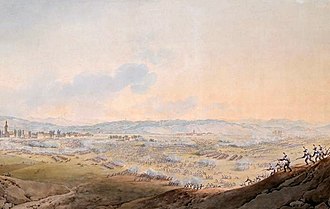
Battle of Eckmühl
The Battle of Eckmühl fought on 22 April 1809, was the turning point of the 1809 Campaign, also known as the War of the Fifth Coalition. Napoleon I had been unprepared for the start of hostilities on 10 April 1809, by the Austrians under Archduke Charles of Austria and for the first time since assuming the French Imperial Crown had been forced to give up the strategic initiative to an opponent. Thanks to the dogged defense waged by the III Corps, commanded by Marshal Davout, and the Bavarian VII Corps, commanded by Marshal Lefebvre, Napoleon was able to defeat the principal Austrian army and wrest the strategic initiative for the remainder of the war.
Austrian Empire
The Austrian Empire, officially known as the Empire of Austria, was a multinational European great power from 1804 to 1867, created by proclamation out of the realms of the Habsburgs. During its existence, it was the third most populous monarchy in Europe after the Russian Empire and the United Kingdom, while geographically, it was the third-largest empire in Europe after the Russian Empire and the First French Empire.
First French Empire
The French Empire, known retroactively as the First French Empire, was the empire ruled by Napoleon Bonaparte, who established French hegemony over much of continental Europe at the beginning of the 19th century. It lasted from 18 May 1804 to 6 April 1814 and again briefly from 20 March 1815 to 7 July 1815, when Napoleon was exiled to Saint Helena.
Napoleon
Napoleon Bonaparte, later known by his regnal name Napoleon I, was a French general and statesman who rose to prominence during the French Revolution and led a series of military campaigns across Europe during the French Revolutionary and Napoleonic Wars from 1796 to 1815. He led the French Republic as First Consul from 1799 to 1804, then ruled the French Empire as Emperor of the French from 1804 to 1814, and briefly again in 1815. He was King of Italy from 1805 to 1814 and Protector of the Confederation of the Rhine from 1806 to 1813.