British prime minister Margaret Thatcher told journalists in Downing Street to "rejoice" upon hearing news of the successful recapture of South Georgia from Argentine forces in the Falklands War.
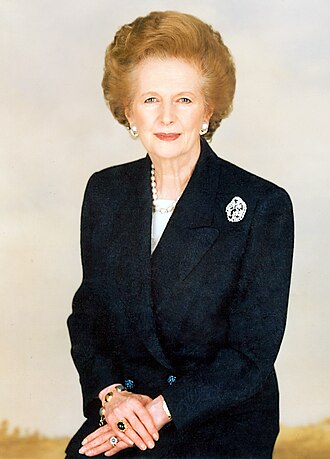
Margaret Thatcher
Margaret Hilda Thatcher, Baroness Thatcher, was a British stateswoman who served as Prime Minister of the United Kingdom from 1979 to 1990 and Leader of the Conservative Party from 1975 to 1990. She was the longest-serving British prime minister of the 20th century and the first woman to hold the position. As prime minister, she implemented policies that came to be known as Thatcherism. A Soviet journalist dubbed her the "Iron Lady", a nickname that became associated with her uncompromising politics and leadership style.
Downing Street
Downing Street is a gated street in Westminster in London that houses the official residences and offices of the Prime Minister of the United Kingdom and the Chancellor of the Exchequer. In a cul-de-sac situated off Whitehall, it is 200 metres (660 ft) long, and a few minutes' walk from the Houses of Parliament. Downing Street was built in the 1680s by Sir George Downing.
Rejoice (Margaret Thatcher)
"Rejoice" was a remark made by British prime minister Margaret Thatcher in Downing Street on 25 April 1982 following a statement read by Secretary of State for Defence John Nott on the successful recapture of South Georgia from Argentine forces, one of the first acts of the Falklands War. A journalist asked, "What happens next, Mr Nott?" at which point Thatcher intervened to state, "just rejoice at that news and congratulate our forces and the Marines", on which she and Nott headed back towards 10 Downing Street. As she reached the doorstep, Thatcher reiterated "rejoice" before entering the building. The words were controversial, with Thatcher's critics regarding them as jingoistic and triumphal, particularly regarding a military operation in which lives may have been lost. Thatcher's supporters regarded the words as a statement of support for British forces and a mark of the relief felt by Thatcher after a successful military operation. The phrase, often paraphrased as "rejoice, rejoice", has been used since in speech and art. Former prime minister Edward Heath uttered the words on Thatcher's resignation in 1990. Labour prime minister Tony Blair received dissent from his backbenchers in 2004 when, after the Iraq War, he asked the House of Commons "whatever mistakes have been made, rejoice that Iraq can have such a future".