Guglielmo Marconi, Italian businessman and inventor, developed Marconi's law, Nobel Prize laureate (died 1937)
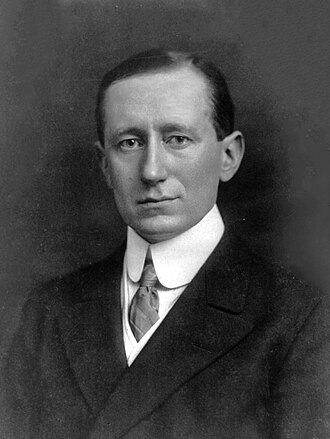
Guglielmo Marconi
Guglielmo Giovanni Maria Marconi, 1st Marquess of Marconi was an Italian electrical engineer, inventor, and politician known for his creation of a practical radio wave-based wireless telegraph system. This led to Marconi being largely credited as the inventor of radio and sharing the 1909 Nobel Prize in Physics with Karl Ferdinand Braun "in recognition of their contributions to the development of wireless telegraphy". His work laid the foundation for the development of radio, television, and all modern wireless communication systems.
Radio propagation
Radio propagation is the behavior of radio waves as they travel, or are propagated, from one point to another in vacuum, or into various parts of the atmosphere. As a form of electromagnetic radiation, like light waves, radio waves are affected by the phenomena of reflection, refraction, diffraction, absorption, polarization, and scattering. Understanding the effects of varying conditions on radio propagation has many practical applications, from choosing frequencies for amateur radio communications, international shortwave broadcasters, to designing reliable mobile telephone systems, to radio navigation, to operation of radar systems.
Nobel Prize in Physics
The Nobel Prize in Physics is an annual award given by the Royal Swedish Academy of Sciences for those who have made the most outstanding contributions to mankind in the field of physics. It is one of the five Nobel Prizes established by the will of Alfred Nobel in 1895 and awarded since 1901, the others being the Nobel Prize in Chemistry, Nobel Prize in Literature, Nobel Peace Prize, and Nobel Prize in Physiology or Medicine. Physics is traditionally the first award presented in the Nobel Prize ceremony.