Wolfgang Pauli, Austrian-Swiss-American physicist and academic, Nobel Prize laureate (died 1958)
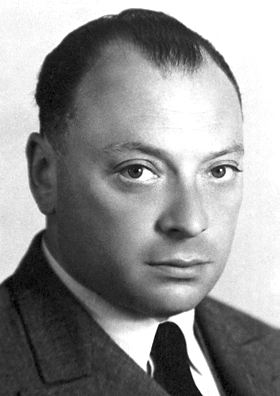
Wolfgang Pauli
Wolfgang Ernst Pauli was an Austrian theoretical physicist and a pioneer of quantum mechanics. In 1945, after having been nominated by Albert Einstein, Pauli received the Nobel Prize in Physics "for the discovery of the Exclusion Principle, also called the Pauli Principle". The discovery involved spin theory, which is the basis of a theory of the structure of matter. To preserve the conservation of energy in beta decay, he posited the existence of a small neutral particle, dubbed the neutrino by Enrico Fermi. The neutrino was detected in 1956.
Nobel Prize in Physics
The Nobel Prize in Physics is an annual award given by the Royal Swedish Academy of Sciences for those who have made the most outstanding contributions to mankind in the field of physics. It is one of the five Nobel Prizes established by the will of Alfred Nobel in 1895 and awarded since 1901, the others being the Nobel Prize in Chemistry, Nobel Prize in Literature, Nobel Peace Prize, and Nobel Prize in Physiology or Medicine. Physics is traditionally the first award presented in the Nobel Prize ceremony.