The Parliament of the United Kingdom passes the People's Budget, the first budget in British history with the expressed intent of redistributing wealth among the British public.
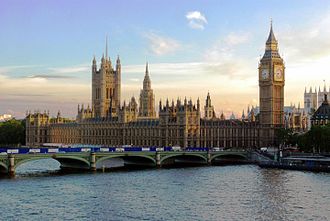
Parliament of the United Kingdom
The Parliament of the United Kingdom of Great Britain and Northern Ireland is the supreme legislative body of the United Kingdom, and may also legislate for the Crown Dependencies and the British Overseas Territories. It meets at the Palace of Westminster in London. Parliament possesses legislative supremacy and thereby holds ultimate power over all other political bodies in the United Kingdom and the Overseas Territories. While Parliament is bicameral, it has three parts: the sovereign, the House of Lords, and the House of Commons. The three parts acting together to legislate may be described as the King-in-Parliament. The Crown normally acts on the advice of the prime minister, and the powers of the House of Lords are limited to only delaying legislation.
People's Budget
The 1909/1910 People's Budget was a proposal of the Liberal government that introduced unprecedented taxes on the lands and incomes of Britain's wealthy to fund new social welfare programmes, such as non-contributary old age pensions under Old Age Pensions Act 1908. It passed the House of Commons in 1909 but was blocked by the House of Lords for a year and became law in April 1910.
Redistribution of income and wealth
Redistribution of income and wealth is the transfer of income and wealth from some individuals to others through a social mechanism such as taxation, welfare, public services, land reform, monetary policies, confiscation, divorce or tort law. The term typically refers to redistribution on an economy-wide basis rather than between selected individuals.
April 29
April 29 is the 119th day of the year in the Gregorian calendar; 246 days remain until the end of the year.