Eighty Years' War: Spain and the Dutch Republic sign the Treaty of Antwerp to initiate twelve years of truce.
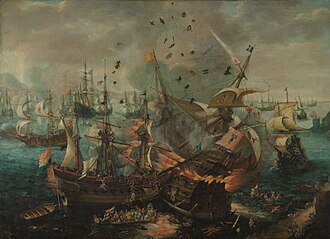
Eighty Years' War
The Eighty Years' War or Dutch Revolt was an armed conflict in the Habsburg Netherlands between disparate groups of rebels and the Spanish government. The causes of the war included the Reformation, centralisation, excessive taxation, and the rights and privileges of the Dutch nobility and cities.
Spanish Empire
The Spanish Empire, sometimes referred to as the Hispanic Monarchy or the Catholic Monarchy, was a colonial empire that existed between 1492 and 1976. In conjunction with the Portuguese Empire, it ushered in the European Age of Discovery. It achieved a global scale, controlling vast portions of the Americas, Africa, various islands in Asia and Oceania, as well as territory in other parts of Europe. It was one of the most powerful empires of the early modern period, becoming known as "the empire on which the sun never sets". At its greatest extent in the late 1700s and early 1800s, the Spanish Empire covered 13.7 million square kilometres, making it one of the largest empires in history.
Dutch Republic
The Republic of the Seven United Netherlands (Dutch: Republiek der Zeven Verenigde Nederlanden), also known as the United Provinces (of the Netherlands), and referred to in historiography as the Dutch Republic, was a confederation that existed from 1588 until the Batavian Revolution in 1795. It was a predecessor state of the present-day Netherlands and the first independent Dutch nation state. The republic was established after seven Dutch provinces in the Spanish Netherlands revolted against Spanish rule, forming a mutual alliance against Spain in 1579 (the Union of Utrecht) and declaring their independence in 1581 (the Act of Abjuration), after which they confederated in 1588 (the Instruction of 12 April 1588) after the States General could not agree on a new monarch. The seven provinces it comprised were Groningen (present-day Groningen), Frisia (present-day Friesland), Overijssel (present-day Overijssel), Guelders (present-day Gelderland), Utrecht (present-day Utrecht), Holland (present-day North Holland and South Holland), and Zeeland (present-day Zeeland).