Ferdinand Magellan's five ships set sail from Seville to circumnavigate the globe. The Basque second-in-command Juan Sebastián Elcano will complete the expedition after Magellan's death in the Philippines.
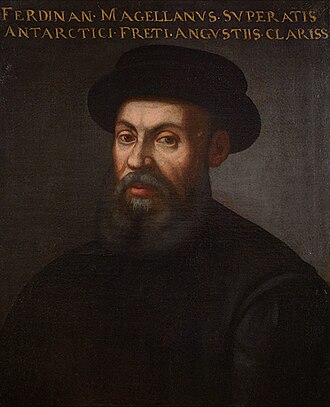
Ferdinand Magellan
Ferdinand Magellan was a Portuguese explorer best known for having planned and led the 1519–22 Spanish expedition to the East Indies. During this expedition, he also discovered the Strait of Magellan, allowing his fleet to pass from the Atlantic into the Pacific Ocean and perform the first European navigation to Asia via the Pacific. Magellan was killed in battle in the Philippines and his crew, commanded by the Spanish Juan Sebastián Elcano, completed the return trip to Spain in 1522 achieving the first circumnavigation of Earth in history.
Seville
Seville is the capital and largest city of the Spanish autonomous community of Andalusia and the province of Seville. It is situated on the lower reaches of the River Guadalquivir, in the southwest of the Iberian Peninsula.
Basques
The Basques are a Southwestern European ethnic group, characterised by the Basque language, a common culture, shared genetic ancestry to the ancient Vascones and Aquitanians, and are considered among the last remaining Paleo-European populations in Europe. Basques are indigenous to, and primarily inhabit, an area traditionally known as the Basque Country —a region that is located around the western end of the Pyrenees on the coast of the Bay of Biscay and straddles parts of north-central Spain and south-western France.
Juan Sebastián Elcano
Juan Sebastián Elcano was a Spanish navigator, ship-owner and explorer of Basque origin, ship-owner and explorer from Getaria, part of the Crown of Castile when he was born, best known for having completed the first circumnavigation of the Earth in the Spanish ship Victoria on the Magellan expedition to the Spice Islands. He received recognition for his achievement by Charles I of Spain with a coat of arms bearing a globe and the Latin motto Primus circumdedisti me.