South Africa is banned from the Olympic Games due to the country's racist policies.
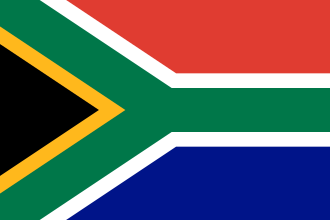
South Africa
South Africa, officially the Republic of South Africa (RSA), is the southernmost country in Africa. Its nine provinces are bounded to the south by 2,798 kilometres of coastline that stretches along the South Atlantic and Indian Ocean; to the north by the neighbouring countries of Namibia, Botswana, and Zimbabwe; to the east and northeast by Mozambique and Eswatini; and it encloses Lesotho. Covering an area of 1,221,037 square kilometres, the country has a population of over 63 million people. Pretoria is the administrative capital, while Cape Town, as the seat of Parliament, is the legislative capital, and Bloemfontein is regarded as the judicial capital. The largest, most populous city is Johannesburg, followed by Cape Town and Durban.
Apartheid-era South Africa and the Olympics
South Africa did not compete at Olympic Games from 1964 to 1988, as a part of the sporting boycott of South Africa during the apartheid era. The South African National Olympic Committee (NOC) was expelled from the International Olympic Committee (IOC) in 1970. In 1991, as part of the transition to multiracial equality, a new NOC was formed and admitted to the IOC, and the country competed at the 1992 Summer Olympics held in Barcelona.
Olympic Games
The modern Olympic Games are the world's preeminent international sporting events. They feature summer and winter sports competitions in which thousands of athletes from around the world participate in a variety of competitions. The Olympic Games, open to both amateur and professional athletes, involves more than 200 teams, each team representing a sovereign state or territory. By default, the Games generally substitute for any world championships during the year in which they take place. The Olympics are staged every four years. Since 1994, they have alternated between the Summer and Winter Olympics every two years during the four-year Olympiad.