events
Eighty Years' War: Siege of Antwerp: Antwerp is captured by Spanish forces under Alexander Farnese, Duke of Parma, who orders Protestants to leave the city and as a result over half of the 100,000 inhabitants flee to the northern provinces.
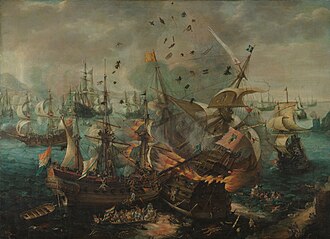
Related Wikipedia articles
Eighty Years' War
War in the Habsburg Netherlands (c. 1566/1568–1648)
The Eighty Years' War or Dutch Revolt was an armed conflict in the Habsburg Netherlands between disparate groups of rebels and the Spanish government. The causes of the war included the Reformation, centralisation, excessive taxation, and the rights and privileges of the Dutch…Source: Wikipedia (CC BY-SA)
Fall of Antwerp
1585 end of siege by Spanish forces against a Dutch garrison in Eighty Years' War
The fall of Antwerp on 17 August 1585 took place during the Eighty Years' War, after a siege lasting over a year from July 1584 until August 1585. The city of Antwerp was the focal point of the Protestant-dominated Dutch Revolt, but was forced to surrender to the Spanish forces…Source: Wikipedia (CC BY-SA)
Antwerp
City located in Flanders, Belgium
Antwerp is a city and a municipality in the Flemish Region of Belgium. It is the capital and largest city of Antwerp Province, and the third-largest municipality in Belgium by area at 208.22 km2 (80.39 sq mi). With a population of 565,039, it is the most populous municipality in…Source: Wikipedia (CC BY-SA)
Spanish Empire
Colonial empire between 1492 and 1976
The Spanish Empire, sometimes referred to as the Hispanic Monarchy or the Catholic Monarchy, was a colonial empire that existed between 1492 and 1976. In conjunction with the Portuguese Empire, it ushered in the European Age of Discovery. It achieved a global scale, controlling…Source: Wikipedia (CC BY-SA)
Alexander Farnese, Duke of Parma
Italian general and governor (1545–1592)
Alexander Farnese was an Italian noble and military leader, who was Duke of Parma, Piacenza and Castro from 1586 to 1592, as well as Governor of the Spanish Netherlands from 1578 to 1592. Nephew to King Philip II of Spain, he served in the Battle of Lepanto and the subsequent…Source: Wikipedia (CC BY-SA)
Protestantism
Major branch of Christianity
Protestantism is a branch of Christianity that emphasizes justification of sinners through faith alone, the teaching that salvation comes by unmerited divine grace, the priesthood of all believers, and the Bible as the sole infallible source of authority for Christian faith and…Source: Wikipedia (CC BY-SA)
Dutch Republic
Predecessor state of the Netherlands (1581–1795)
The Republic of the Seven United Netherlands (Dutch: Republiek der Zeven Verenigde Nederlanden), also known as the United Provinces (of the Netherlands), and referred to in historiography as the Dutch Republic, was a confederation that existed from 1588 until the Batavian…Source: Wikipedia (CC BY-SA)