Leading presidential hopeful Luis Carlos Galán is assassinated near Bogotá in Colombia.
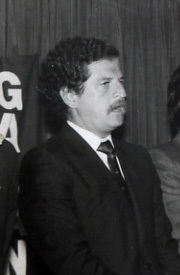
Luis Carlos Galán
Luis Carlos Galán Sarmiento was a Colombian liberal politician and journalist who ran for the Presidency of Colombia on two occasions, the first time for the political movement New Liberalism that he founded in 1979. The movement was an offspring of the mainstream Colombian Liberal Party, and with mediation of former Liberal president Julio César Turbay Ayala, Galán returned to the Liberal party in 1989 and sought the nomination for the 1990 presidential election, but was assassinated before the vote took place.
Bogotá
Bogotá, officially Bogotá, Distrito Capital, abbreviated Bogotá, D.C., and formerly known as Santa Fe de Bogotá during the Spanish Imperial period and between 1991 and 2000, is the capital and largest city of Colombia. The city is administered as the Capital District, as well as the capital of, though not politically part of, the surrounding department of Cundinamarca. Bogotá is a territorial entity of the first order, with the same administrative status as the departments of Colombia. It is the main political, economic, administrative, industrial, cultural, aeronautical, technological, scientific, medical and educational center of the country and northern South America.
Colombia
Colombia, officially the Republic of Colombia, is a country primarily located in South America with insular regions in North America. The Colombian mainland is bordered by the Caribbean Sea to the north, Venezuela to the east and northeast, Brazil to the southeast, Peru and Ecuador to the south and southwest, the Pacific Ocean to the west, and Panama to the northwest. Colombia is divided into 32 departments. The Capital District of Bogotá is also the country's largest city hosting the main financial and cultural hub. Other major urban areas include Medellín, Cali, Barranquilla, Cartagena, Santa Marta, Cúcuta, Ibagué, Villavicencio and Bucaramanga. It covers an area of 1,141,748 square kilometers and has a population of around 52 million. Its rich cultural heritage—including language, religion, cuisine, and art—reflects its history as a colony, fusing cultural elements brought by immigration from Europe and the Middle East, with those brought by the African diaspora, as well as with those of the various Indigenous civilizations that predate colonization. Spanish is the official language, although Creole, English and 64 other languages are recognized regionally.