Russian Civil War: Peasants in Tambov Governorate began a rebellion against the Bolshevik government of Soviet Russia.
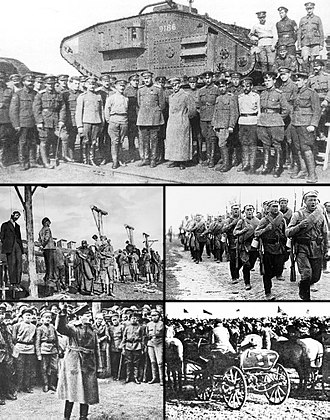
Russian Civil War
The Russian Civil War was a multi-party civil war in the former Russian Empire sparked by the 1917 overthrowing of the Russian Provisional Government in the October Revolution, as many factions vied to determine Russia's political future. It resulted in the formation of the Russian Socialist Federative Soviet Republic and later the Soviet Union in most of its territory. Its finale marked the end of the Russian Revolution, which was one of the key events of the 20th century.
Tambov Governorate
Tambov Governorate was an administrative-territorial unit (guberniya) of the Russian Empire, the Russian Republic, and the Russian SFSR, with its capital in Tambov. It was located between 51°14' and 55°6' north and between 38°9' and 43°38' east. It bordered Vladimir Governorate and Nizhny Novgorod Governorate to north, Penza Governorate and Saratov Governorate to the east, Voronezh Governorate to south and west, and Oryol Governorate, Tula Governorate, and Ryazan Governorate to the west.
Tambov Rebellion
The Tambov Rebellion of 1920–1922 was one of the largest and best-organized peasant rebellions challenging the Bolshevik government during the Russian Civil War. The uprising took place in the territories of the modern Tambov Oblast and part of the Voronezh Oblast, less than 500 kilometres (300 mi) southeast of Moscow.
Bolsheviks
The Bolsheviks, led by Vladimir Lenin, were a radical faction of the Marxist Russian Social Democratic Labour Party (RSDLP) which split with the Mensheviks at the Second Party Congress in 1903. The Bolshevik party, formally established in 1912, seized power in Russia in the October Revolution of 1917, and was later renamed the Russian Communist Party, All-Union Communist Party, and ultimately the Communist Party of the Soviet Union. Its ideology, based on Leninist and later Marxist–Leninist principles, became known as Bolshevism.