Second Anglo-Dutch War: Rear Admiral Robert Holmes leads a raid on the Dutch island of Terschelling, destroying 150 merchant ships, an act later known as "Holmes's Bonfire".
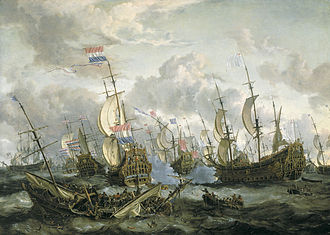
Second Anglo-Dutch War
The Second Anglo-Dutch War began on 4 March 1665 and concluded with the signing of the Treaty of Breda on 31 July 1667. It was one in a series of naval wars between England and the Dutch Republic, driven largely by commercial disputes.
Robert Holmes (Royal Navy officer)
Admiral Sir Robert Holmes was an English Royal Navy officer. He participated in the second and third Anglo-Dutch Wars, both of which he is, by some, credited with having started. He was made Governor of the Isle of Wight, where he is buried in Yarmouth Parish Church.
Terschelling
Terschelling is a municipality and an island in the northern Netherlands, one of the West Frisian Islands. It is situated between the islands of Vlieland and Ameland.
Holmes's Bonfire
Holmes's Bonfire was a raid on the Vlie estuary in the Netherlands, executed by the English Fleet during the Second Anglo-Dutch War on 19 and 20 August 1666 New Style. The attack, named after the commander of the landing force, Rear-Admiral Robert Holmes, was successful in destroying by fire a large merchant fleet of 140 ships. During the same action, the town of West-Terschelling was burnt down, which caused outrage in the Dutch Republic.