Pluto (pictured) was photographed for the first time at the Yerkes Observatory in Williams Bay, Wisconsin, U.S., 21 years before it was officially discovered by Clyde Tombaugh.
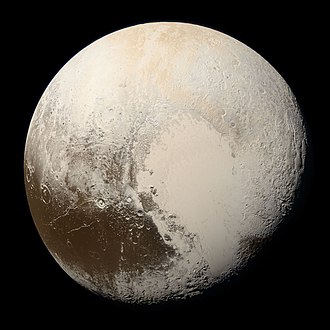
Pluto
Pluto is a dwarf planet in the Kuiper belt, a ring of bodies beyond the orbit of Neptune. It is the ninth-largest and tenth-most-massive known object to directly orbit the Sun. It is the largest known trans-Neptunian object by volume by a small margin, but is less massive than Eris. Like other Kuiper belt objects, Pluto is made primarily of ice and rock and is much smaller than the inner planets. Pluto has roughly one-sixth the mass of the Moon and one-third its volume. Originally considered a planet, its classification was changed when astronomers adopted a new definition of planet.
Yerkes Observatory
Yerkes Observatory is an astronomical observatory located in Williams Bay, Wisconsin, United States. The observatory was operated by the University of Chicago Department of Astronomy and Astrophysics from its founding in 1897 until 2018. Ownership was transferred to the non-profit Yerkes Future Foundation (YFF) in May 2020, which began millions of dollars of restoration and renovation of the historic building and grounds. Yerkes re-opened for public tours and programming in May 2022.
Williams Bay, Wisconsin
Williams Bay is a village in Walworth County, Wisconsin, United States. It is one of three municipalities on Geneva Lake. The population was 2,953 at the 2020 census. On June 22, 2024 the town was hit by an EF-1 tornado, there were no injuries or fatalities, but the storm caused some areas of considerable damage.
Clyde Tombaugh
Clyde William Tombaugh was an American astronomer and telescope maker, best known for discovering Pluto in 1930, marking the first detection of what would eventually be recognized as the Kuiper belt. At the time, Pluto was referred to as the ninth planet in the Solar System, a classification that stood for over seven decades.