Second Barons' War: Battle of Evesham: The army of Prince Edward (the future king Edward I of England) defeats the forces of rebellious barons led by Simon de Montfort, 6th Earl of Leicester, killing de Montfort and many of his allies.
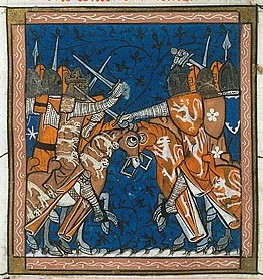
Second Barons' War
The Second Barons' War (1264–1267) was a civil war in England between the forces of barons led by Simon de Montfort against the royalist forces of King Henry III, led initially by the king himself and later by his son, the future King Edward I. The barons sought to force the king to rule with a council of barons, rather than through his favourites. The war also involved a series of massacres of Jews by some of de Montfort's supporters in attacks aimed at seizing and destroying evidence of baronial debts. To bolster the initial success of his baronial regime, de Montfort sought to broaden the social foundations of parliament by extending the franchise to the commons for the first time. However, after a rule of just over a year, de Montfort was killed by forces loyal to the king at the Battle of Evesham.
Battle of Evesham
The Battle of Evesham was one of the two main battles of 13th century England's Second Barons' War. It marked the defeat of Simon de Montfort, Earl of Leicester, and the rebellious barons by the future King Edward I, who led the forces of his father, King Henry III. It took place on 4 August 1265, near the town of Evesham, Worcestershire.
Edward I of England
Edward I, also known as Edward Longshanks and the Hammer of the Scots, was King of England from 1272 to 1307. Concurrently, he was Lord of Ireland, and from 1254 to 1306 ruled Gascony as Duke of Aquitaine in his capacity as a vassal of the French king. Before his accession to the throne, he was commonly referred to as the Lord Edward. The eldest son of Henry III, Edward was involved from an early age in the political intrigues of his father's reign. In 1259, he briefly sided with a baronial reform movement, supporting the Provisions of Oxford. After reconciling with his father, he remained loyal throughout the subsequent armed conflict, known as the Second Barons' War. After the Battle of Lewes, Edward was held hostage by the rebellious barons, but escaped after a few months and defeated the baronial leader Simon de Montfort at the Battle of Evesham in 1265. Within two years, the rebellion was extinguished and, with England pacified, Edward left to join the Ninth Crusade to the Holy Land in 1270. He was on his way home in 1272 when he was informed of his father's death. Making a slow return, he reached England in 1274 and was crowned at Westminster Abbey.