The Soviet Union informed Turkey that the way in which the latter was handling the Turkish straits no longer represented the security interests of its fellow Black Sea nations, escalating the Turkish Straits crisis.
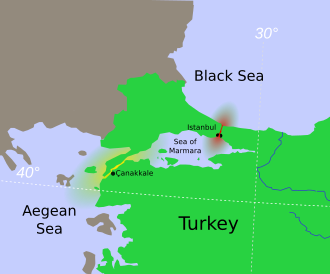
Turkish straits
The Turkish Straits are two internationally significant waterways in northwestern Turkey. The Straits create a series of international passages that connect the Aegean and Mediterranean seas to the Black Sea. They consist of the Dardanelles and the Bosphorus. The straits are on opposite ends of the Sea of Marmara. The straits and the Sea of Marmara are part of the sovereign sea territory of Turkey and are treated as Turkish internal waters.
Black Sea
The Black Sea is a marginal mediterranean sea lying between Europe and Asia, east of the Balkans, south of the East European Plain, west of the Caucasus, and north of Anatolia. It is bounded by Bulgaria, Georgia, Romania, Russia, Turkey, and Ukraine. The Black Sea is supplied by major rivers, principally the Danube, Dnieper and Dniester. Consequently, while six countries have a coastline on the sea, its drainage basin includes parts of 24 countries in Europe.
Turkish Straits crisis
The Turkish Straits crisis was a Cold War–era territorial conflict between the Soviet Union and Turkey. Turkey had remained officially neutral throughout most of the Second World War. After the war ended, Turkey was pressured by the Soviet government to institute joint military control of passage through the Turkish Straits, which connected the Black Sea to the Mediterranean. When the Turkish government refused, tensions in the region rose, leading to a Soviet show of force and demands for territorial concessions along the Georgia–Turkey border.