Thor Heyerdahl's balsa wood raft, the Kon-Tiki, smashes into the reef at Raroia in the Tuamotu Islands after a 101-day, 7,000 kilometres (4,300 mi) journey across the Pacific Ocean in an attempt to prove that pre-historic peoples could have traveled from South America.
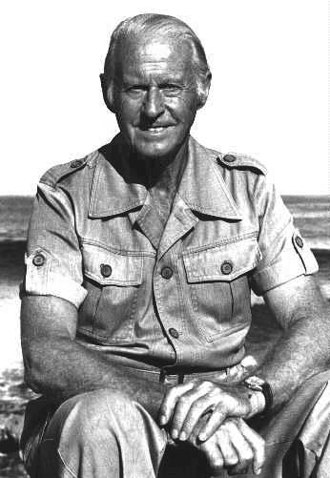
Thor Heyerdahl
Thor Heyerdahl KStJ was a Norwegian adventurer and ethnographer with a background in biology with specialization in zoology, botany and geography.
Ochroma
Ochroma pyramidale, commonly known as balsa, is a large, fast-growing tree native to the Americas. It is the sole member of the genus Ochroma, and is classified in the subfamily Bombacoideae of the mallow family Malvaceae. The tree is famous for its wide usage in woodworking, due to its softness and its high strength compared to its low density. The name balsa is the Spanish word for "raft" and the Portuguese word for ferry.
Kon-Tiki expedition
The Kon-Tiki expedition was a 1947 journey by raft across the Pacific Ocean from South America to the Polynesian islands, led by Norwegian explorer and writer Thor Heyerdahl. The raft was named Kon-Tiki after the Inca god Viracocha, for whom "Kon-Tiki" was said to be an old name. Heyerdahl's book on the expedition was entitled The Kon-Tiki Expedition: By Raft Across the South Seas. A 1950 documentary film won the Academy Award for Best Documentary Feature. A 2012 dramatized feature film was nominated for the Academy Award for Best Foreign Language Film.
Reef
A reef is a ridge or shoal of rock, coral, or similar relatively stable material lying beneath the surface of a natural body of water. Many reefs result from natural, abiotic (non-living) processes such as deposition of sand or wave erosion planning down rock outcrops. However, reefs such as the coral reefs of tropical waters are formed by biotic (living) processes, dominated by corals and coralline algae. Artificial reefs, such as shipwrecks and other man-made underwater structures, may occur intentionally or as the result of an accident. These are sometimes designed to increase the physical complexity of featureless sand bottoms to attract a more diverse range of organisms. They provide shelter to various aquatic animals which help prevent extinction. Another reason reefs are put in place is for aquaculture, and fish farmers who are looking to improve their businesses sometimes invest in them. Reefs are often quite near to the surface, but not all definitions require this.