The Blue Lotus, the fifth volume of The Adventures of Tintin by the Belgian cartoonist Hergé and noted for its emphasis on countering negative misconceptions of Chinese people, began serialisation.
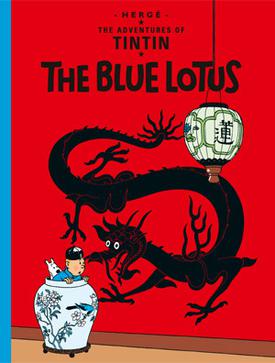
The Blue Lotus
The Blue Lotus is the fifth volume of The Adventures of Tintin, the comics series by Belgian cartoonist Hergé. Commissioned by the conservative Belgian newspaper Le Vingtième Siècle for its children's supplement Le Petit Vingtième, it was serialised weekly from August 1934 to October 1935 before being published in a collected volume by Casterman in 1936. Continuing where the plot of the previous story, Cigars of the Pharaoh, left off, the story tells of young Belgian reporter Tintin and his dog Snowy, who are invited to China in the middle of the 1931 Japanese invasion, where Tintin reveals the machinations of Japanese spies and uncovers a drug-smuggling ring.
The Adventures of Tintin
The Adventures of Tintin is a series of 24 comic albums created by Belgian cartoonist Georges Remi, who wrote under the pen name Hergé. The series was one of the most popular European comics of the 20th century. By 2007, a century after Hergé's birth in 1907, Tintin had been published in more than 70 languages with sales of more than 200 million copies, and had been adapted for radio, television, theatre, and film.
Hergé
Georges Prosper Remi, known by the pen name Hergé, from the French pronunciation of his reversed initials RG, was a Belgian comic strip artist. He is best known for creating The Adventures of Tintin, the series of comic albums that are considered one of the most popular European comics of the 20th century. He was also responsible for two other well-known series, Quick & Flupke (1930–1940) and The Adventures of Jo, Zette and Jocko (1936–1957). His works were executed in his distinctive ligne claire drawing style.
Chinese people
The Chinese people, or simply Chinese, are people or ethnic groups identified with China, usually through ethnicity, nationality, citizenship, or other affiliation.