Sergei Kirov is assassinated, paving way for the repressive Great Purge, and Vinnytsia massacre by General Secretary of the Communist Party of the Soviet Union, Joseph Stalin.
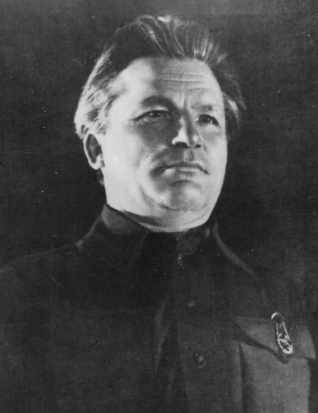
Sergei Kirov
Sergei Mironovich Kirov was a Russian and Soviet politician and Bolshevik revolutionary. Kirov was an early revolutionary in the Russian Empire and a member of the Bolshevik faction of the Russian Social Democratic Labour Party. Kirov became an Old Bolshevik and personal friend to Joseph Stalin, rising through the Communist Party of the Soviet Union ranks to become head of the party in Leningrad and a member of the Politburo.
Great Purge
The Great Purge or Great Terror, also known as the Year of '37 and the Yezhovshchina, was a political purge in the Soviet Union from 1936 to 1938. After the assassination of Sergei Kirov by Leonid Nikolaev in 1934, Joseph Stalin launched a series of show trials known as the Moscow trials to remove suspected dissenters from the Communist Party of the Soviet Union. The term "great purge" was popularized by historian Robert Conquest in his 1968 book, The Great Terror, whose title alluded to the French Revolution's Reign of Terror.
Vinnytsia massacre
The Vinnytsia massacre was the mass execution of between 9,000 and 11,000 people in the Ukrainian town of Vinnytsia by the Soviet secret police NKVD during the Great Purge in 1937–1938, which Nazi Germany discovered during its occupation of Ukraine in 1943. The investigation of the site first conducted by the international Katyn Commission coincided with the discovery of a similar mass murder site of Polish prisoners of war in Katyn. Among the 679 dead identified by the Germans in 1943, there were also a certain number of Russians and 28 Poles. Nazi propaganda invoked mention of the massacre to illustrate communist terror by the Soviet Union.
General Secretary of the Communist Party of the Soviet Union
The General Secretary of the Central Committee of the Communist Party of the Soviet Union was the leader of the Communist Party of the Soviet Union (CPSU). From 1924 until the country's dissolution in 1991, the officeholder was the recognized leader of the Soviet Union. Prior to Joseph Stalin's accession, the position was not viewed as an important role in Vladimir Lenin's government and previous occupants had been responsible for technical rather than political decisions.