Abdication Crisis: Edward VIII's abdication as King of the United Kingdom and the British Dominions beyond the Seas, and Emperor of India, becomes effective.
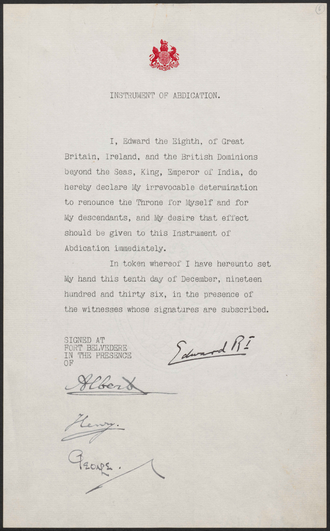
Abdication of Edward VIII
In early December 1936, a constitutional crisis in the British Empire arose when King Edward VIII proposed to marry Wallis Simpson, an American socialite who was divorced from her first husband and was in the process of divorcing her second.
Edward VIII
Edward VIII, later known as the Duke of Windsor, was King of the United Kingdom and the British Dominions, and Emperor of India, from 20 January 1936 until his abdication in December of the same year.
Dominion
A dominion was any of several largely self-governing countries of the British Empire, once known collectively as the British Commonwealth of Nations. Progressing from colonies, their degrees of colonial self-governance increased unevenly over the late 19th century through the 1930s. Vestiges of empire lasted in some dominions well into the late 20th century. With the evolution of the British Empire following the 1945 conclusion of the Second World War into the modern Commonwealth of Nations, finalised in 1949, the dominions became independent states, either as Commonwealth republics or Commonwealth realms.
Emperor of India
Emperor of India was a title used by British monarchs from 1 May 1876 to 22 June 1948 to signify their sovereignty over the British Indian Empire as its imperial head of state. The image of the Emperor or Empress appeared on Indian currency, in government buildings, railway stations, courts, on statues etc. Oaths of allegiance were made to the Emperor or Empress and the lawful successors by the governors-general, princes, governors, commissioners in India in events such as imperial durbars.