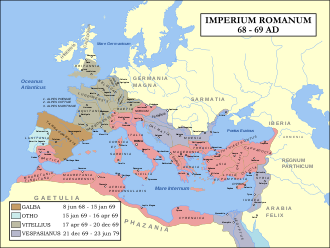
Vespasian is proclaimed Emperor of Rome; his predecessor, Vitellius, attempts to abdicate but is captured and killed at the Gemonian stairs.
AD 69
AD 69 (LXIX) was a common year starting on Sunday of the Julian calendar. In the Roman Empire, it was known as the Year of the consulship of Galba and Vinius. The denomination AD 69 for this year has been used since the early medieval period, when the Anno Domini calendar era became the prevalent method in Europe for naming years.
Vespasian
Vespasian was Roman emperor from 69 to 79. The last emperor to reign in the Year of the Four Emperors, he founded the Flavian dynasty, which ruled the empire for 27 years. His fiscal reforms and consolidation of the empire brought political stability and a vast building program.
Roman emperor
The Roman emperor was the ruler and monarchical head of state of the Roman Empire, starting with the granting of the title augustus to Octavian in 27 BC. The term emperor is a modern convention, and did not exist as such during the Empire. When a given Roman is described as becoming emperor in English, it generally reflects his accession as augustus, and later as basileus. Another title used was imperator, originally a military honorific, and caesar, originally a cognomen. Early emperors also used the title princeps alongside other Republican titles, notably consul and pontifex maximus.
Vitellius
Aulus Vitellius was Roman emperor for eight months, from 19 April to 20 December AD 69. Vitellius became emperor following the quick succession of the previous emperors Galba and Otho, in a year of civil war known as the Year of the Four Emperors. Vitellius added the honorific Germanicus to his name instead of Caesar upon his accession. Like his predecessor, Otho, Vitellius attempted to rally public support to his cause by honoring and imitating Nero who remained popular in the empire.