The Cassini orbiter releases Huygens probe which successfully landed on Saturn's moon Titan on January 14, 2005.
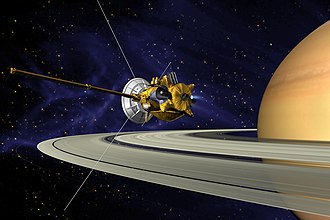
Cassini–Huygens
Cassini–Huygens, commonly called Cassini, was a space-research mission by NASA, the European Space Agency (ESA), and the Italian Space Agency (ASI) to send a space probe to study the planet Saturn and its system, including its rings and natural satellites. The Flagship-class robotic spacecraft comprised both NASA's Cassini space probe and ESA's Huygens lander, which landed on Saturn's largest moon, Titan. Cassini was the fourth space probe to visit Saturn and the first to enter its orbit, where it stayed from 2004 to 2017. The two craft took their names from the astronomers Giovanni Cassini and Christiaan Huygens.
Huygens (spacecraft)
Huygens was an atmospheric entry robotic space probe that landed successfully on Saturn's moon Titan in 2005. Built and operated by the European Space Agency (ESA), launched by NASA, it was part of the Cassini–Huygens mission and became the first spacecraft to land on Titan and the farthest landing from Earth a spacecraft has ever made. The probe was named after the 17th-century Dutch astronomer Christiaan Huygens, who discovered Titan in 1655.