Constantin Cantemir, Prince of Moldavia, and the Holy Roman Empire sign a secret treaty in Sibiu, stipulating that Moldavia would support the actions led by the House of Habsburg against the Ottoman Empire.
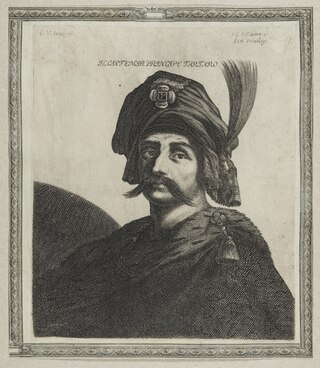
Constantin Cantemir
Constantin or Constantine Cantemir was a Moldavian nobleman, soldier, and statesman who served as voivode between 25 June 1685 and 27 March 1693. He established the Cantemir dynasty which—with interruptions—ruled Moldavia prior to the imposition of phanariot rule.
Moldavia
Moldavia is a historical region and former principality in Eastern Europe, corresponding to the territory between the Eastern Carpathians and the Dniester River. An initially independent and later autonomous state, it existed from the 14th century to 1859, when it united with Wallachia as the basis of the modern Romanian state; at various times, Moldavia included the regions of Bessarabia, all of Bukovina and Hertsa. The region of Pokuttya was also part of it for a period of time.
Holy Roman Empire
The Holy Roman Empire, also known as the Holy Roman Empire of the German Nation after 1512, was a polity in Central and Western Europe, usually headed by the Holy Roman Emperor. It developed in the Early Middle Ages, and lasted for a millennium until its dissolution in 1806 during the Napoleonic Wars. For most of its history the Empire comprised the entirety of the modern countries of Germany, Czechia, Austria, the Netherlands, Switzerland, Slovenia, and Luxembourg, most of north-central Italy and southern Belgium, and large parts of modern-day east France and west Poland.
Sibiu
Sibiu is a city in central Romania, situated in the historical region of Transylvania. Located some 275 km (171 mi) north-west of Bucharest, the city straddles the Cibin River, a tributary of the Olt River. Now the seat of Sibiu County, between 1692 and 1791 and 1849–65 Sibiu was the capital of the Principality of Transylvania. Until 1876, the Hecht hause in Sibiu served as the seat of the Transylvanian Saxon University.