Zulu impis massacred about 532 Voortrekkers, Khoekhoe, and Basuto near present-day Weenen, South Africa.
Impi
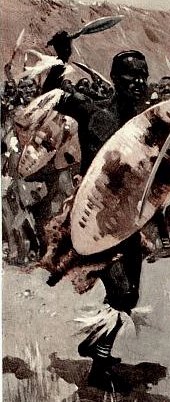
Impi is a Nguni word meaning war or combat and by association any body of men gathered for war, for example impi ya masosha is a term denoting an army. Impi were formed from regiments from large militarised homesteads. In English impi is often used to refer to a Zulu regiment, which is called an ibutho in Zulu, or the army of the Zulu Kingdom.
Weenen massacre
The Weenen Massacre, also known as the Bloukrans Massacre, was a series of coordinated attacks by Zulu forces under King Dingane on Voortrekker encampments in Natal, present-day South Africa, on 17–18 February 1838. Following the killing of Voortrekker leader Piet Retief and his delegation at Dingane’s royal kraal, uMgungundlovu, on 6 February 1838, approximately 500 Voortrekkers and their servants, including 185 children and 56 women, were killed across sites at Doringkop, Bloukrans, Moordspruit, Rensburgspruit, and Weenen. A pivotal event in the Great Trek, the massacre escalated conflict between the Voortrekkers and the Zulu, leading to the Battle of Blood River in December 1838.
Great Trek
The Great Trek was a northward migration of Dutch-speaking settlers who travelled by wagon trains from the Cape Colony into the interior of modern South Africa from 1836 onwards, seeking to live beyond the Cape's British colonial administration. The Great Trek resulted from the culmination of tensions between rural descendants of the Cape's original European settlers, known collectively as Boers, and the British. It was also reflective of an increasingly common trend among individual Boer communities to pursue an isolationist and semi-nomadic lifestyle away from the developing administrative complexities in Cape Town. Boers who took part in the Great Trek identified themselves as voortrekkers, meaning "pioneers" or "pathfinders" in Dutch and Afrikaans.