Dozens of Euromaidan anti-government protesters died in Ukraine's capital Kyiv, many reportedly killed by snipers.
Euromaidan
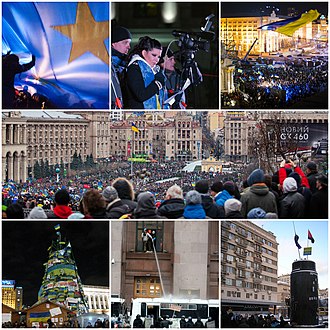
Euromaidan, or the Maidan Uprising, was a wave of demonstrations and civil unrest in Ukraine, which began on 21 November 2013 with large protests in Maidan Nezalezhnosti in Kyiv. The protests were sparked by President Viktor Yanukovych's sudden decision not to sign the European Union–Ukraine Association Agreement, instead choosing closer ties to Russia and the Eurasian Economic Union. Ukraine's parliament had overwhelmingly approved of finalizing the Agreement with the EU, but Russia had put pressure on Ukraine to reject it. The scope of the protests widened, with calls for the resignation of Yanukovych and the Azarov government. Protesters opposed what they saw as widespread government corruption, abuse of power, human rights violations, and the influence of oligarchs. Transparency International named Yanukovych as the top example of corruption in the world. The violent dispersal of protesters on 30 November caused further anger. Euromaidan was the largest democratic mass movement in Europe since 1989 and led to the 2014 Revolution of Dignity.
Maidan casualties
Altogether, 108 civilian protesters and 13 police officers were killed in Ukraine's Revolution of Dignity, which was the culmination of the Euromaidan protest movement. The deaths occurred in January and February 2014; most of them on 20 February, when police snipers fired on anti-government activists in Kyiv. The slain activists are known in Ukraine as the Heavenly Hundred or Heavenly Company. By June 2016, 55 people had been charged in relation to the deaths of protesters, including 29 former members of the Berkut special police force, ten titushky or loyalists of the former government, and ten former government officials.
Kyiv
Kyiv, also Kiev, is the capital and most populous city of Ukraine. Located in the north-central part of the country, it straddles both sides of the Dnieper River. As of 1 January 2022, its population was 2,952,301, making Kyiv the seventh-most populous city in Europe. Kyiv is an important industrial, scientific, educational, and cultural center. It is home to many high-tech industries, higher education institutions, and historical landmarks. The city has an extensive system of public transport and infrastructure, including the Kyiv Metro.