Second Red Scare: US Senator Joseph McCarthy accuses the United States Department of State of being filled with Communists.
McCarthyism
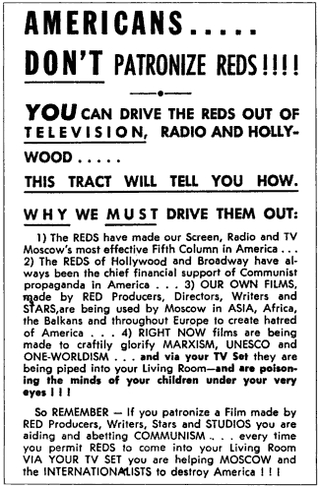
McCarthyism is a political practice defined by the political repression and persecution of left-wing individuals and a campaign spreading fear of communist and Soviet influence on American institutions and of Soviet espionage in the United States during the late 1940s through the 1950s, heavily associated with the Second Red Scare, also known as the McCarthy Era. After the mid-1950s, U.S. senator Joseph McCarthy, who had spearheaded the campaign, gradually lost his public popularity and credibility after several of his accusations were found to be false. The U.S. Supreme Court under Chief Justice Earl Warren made a series of rulings on civil and political rights that overturned several key laws and legislative directives, and helped bring an end to the Second Red Scare. Historians have suggested since the 1980s that as McCarthy's involvement was less central than that of others, a different and more accurate term should be used instead that more accurately conveys the breadth of the phenomenon, and that the term McCarthyism is, in the modern day, outdated. Ellen Schrecker has suggested that Hooverism, after FBI head J. Edgar Hoover, is more appropriate. Following the end of the Cold War, unearthed documents revealed substantial Soviet spy activity in the United States, although many of the agents were never properly identified by McCarthy.
United States Senate
The United States Senate is a chamber of the bicameral United States Congress; it is the upper house, with the U.S. House of Representatives being the lower house. Together, the Senate and House have the authority under Article One of the U.S. Constitution to pass or defeat federal legislation.
Joseph McCarthy
Joseph Raymond McCarthy was an American politician who served as a Republican U.S. Senator from Wisconsin from 1947 until his death in 1957. Beginning in 1950, McCarthy became the most visible public face of a period in the United States in which Cold War tensions fueled fears of widespread communist subversion. He alleged that numerous communists and Soviet spies and sympathizers had infiltrated the United States federal government, universities, film industry, and elsewhere. Ultimately he was censured by the Senate in 1954 for refusing to cooperate with and abusing members of the committee established to investigate whether or not he should be censured. The term "McCarthyism", coined in 1950 in reference to McCarthy's practices, was soon applied to similar anti-communist activities. Today the term is used more broadly to mean demagogic, reckless, and unsubstantiated accusations, as well as public attacks on the character or patriotism of political opponents.