Twenty-year-old Francis, Duke of Brittany, succeeds to the French throne following the death of his father-in-law, Louis XII.
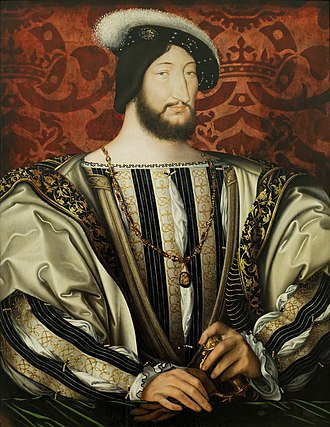
Historical Background
Francis I was born into the French royal family in 1494, the son of Charles, Count of Angoulême, and Louise of Savoy. His life would be marked by the weight of destiny as he prepared to ascend the throne.
In an unusual turn of events, Francis succeeded his first cousin once removed and father-in-law Louis XII in 1515. Louis, who had no legitimate sons, passed away leaving behind a vast kingdom for his young successor to inherit.
The Event
Francis I's reign began amidst the political complexities of the early 16th century. His first significant challenge came in the form of war with the Holy Roman Empire, led by Charles V, the powerful ruler of Spain and Germany.
Despite the odds stacked against him, Francis demonstrated his leadership abilities on the battlefield at Marignano in 1515. The decisive victory over the combined forces of the Habsburg dynasty solidified Francis' position as a formidable European monarch.
Why This Moment Mattered
The Battle of Marignano was more than just a military victory for Francis I. It served as a testament to his ability to rule and navigate the intricate web of alliances and rivalries that characterized Europe during this period.
By defeating Charles V, Francis asserted France's place among the great powers of Europe, setting the stage for centuries of political and cultural influence.
Lasting Impact
The legacy of Francis I extends beyond his military conquests. Under his reign, the arts flourished as he patronized artists such as Leonardo da Vinci and Michelangelo. The Renaissance spirit that characterized his court would leave an indelible mark on French culture.
Moreover, his marriage to Claude de France produced a male heir, Henry II, ensuring the continuation of the Valois dynasty. Francis I's life and reign would shape not only his own time but also the future of France for generations to come.
Historical Background
France, as we know it today, has a long and storied history that dates back to the establishment of the Kingdom of West Francia in 843. This marked the beginning of over a thousand years of rule by French monarchs.
The kingdom was formed from the division of Charlemagne's vast Carolingian Empire. The fragmentation of power allowed local leaders and nobles to assert their influence, setting a pattern that would persist throughout France's history.
The Event
Although France has been ruled by numerous monarchs, specific events have shaped the nation significantly. The end of the Second French Empire in 1870 is one such instance. The empire, established by Napoleon Bonaparte, brought about radical changes in France's political and social landscape.
Why This Moment Mattered
The fall of the Second French Empire signaled the end of an era. The empire had brought about centralization of power, modernization, and expansion beyond France's borders. However, it was also marked by political instability and military defeats.
The collapse of the empire led to the establishment of the Third Republic, which aimed to address some of these issues. This transition was a critical moment in French history as it set the stage for the nation's future development.
Lasting Impact
The impact of this event can still be felt today. The Third Republic laid the groundwork for France's democratic system and modern political institutions. The republic also marked a shift away from empire-building and military conquest, setting France on a path towards peace and stability.
Moreover, the fall of the Second French Empire led to a reevaluation of Napoleon Bonaparte's legacy. While he is still considered one of France's greatest leaders, his rule is now seen as complex and imperfect, with both achievements and failures.
Historical Background
Born into royalty as the son of Charles, Duke of Orléans, and Marie of Cleves, Louis XII was destined for greatness. However, his path to the throne was not a straightforward one.
In 1498, his cousin Charles VIII passed away without an heir, leaving Louis with an unexpected opportunity. He ascended to the French throne, marking the beginning of his reign that would last until 1515.
But his rule didn't stop there. In 1501, he also became King of Naples, expanding his territories significantly.
The Event
One significant event during Louis XII's reign was his marriage to Anne of Brittany in 1499. This union was a strategic move aimed at consolidating power and ending the Breton War of Succession.
However, the marriage proved to be short-lived as Anne passed away just five years later in 1502.
Why This Moment Mattered
Louis XII's reign was marked by political alliances and strategic marriages that helped maintain peace within France and strengthen its position in Europe. His marriage to Anne of Brittany, although brief, was crucial in achieving this balance.
The king's ability to navigate complex political landscapes allowed him to secure territories such as Naples and maintain a strong alliance with the influential Medici family in Italy.
Lasting Impact
Louis XII's reign laid the groundwork for the French Renaissance, setting the stage for cultural and intellectual growth that would flourish under his successors. His strategic alliances helped establish France as a major power in Europe, shaping its future for generations to come.
Historical Background
The Gregorian Calendar, the one we commonly use today, was introduced by Pope Gregory XIII in October 1582. It replaced the Julian Calendar that had been in place for over a millennium. The new calendar aimed to correct the discrepancy between the solar year and the calendar year, making it more accurate.
The Event
January 1, as we know it today, marks the first day of the new year in the Gregorian Calendar. This transition from one year to the next takes place annually on this date, with a total of 364 days remaining until the end of the year.
Why This Moment Mattered
The significance of January 1 lies in its role as a symbolic reset. It provides an opportunity for fresh starts and resolutions, making it a much-anticipated day for many around the world. The shift from the Julian Calendar to the Gregorian Calendar on this date also marked a crucial step towards scientific accuracy and standardization.
Lasting Impact
January 1 continues to hold its significance as the first day of the year in the Gregorian Calendar. It remains a day of celebration, reflection, and anticipation for countless individuals worldwide.
Related Wikipedia articles
Francis I of France
King of France from 1515 to 1547
Francis I was King of France from 1515 until his death in 1547. He was the son of Charles, Count of Angoulême, and Louise of Savoy. He succeeded his first cousin once removed and father-in-law Louis XII, who died without a legitimate son.Source: Wikipedia (CC BY-SA)
List of French monarchs
France was ruled by monarchs from the establishment of the kingdom of West Francia in 843 until the end of the Second French Empire in 1870, with several interruptions.Source: Wikipedia (CC BY-SA)
Louis XII
King of France from 1498 to 1515
Louis XII, also known as Louis of Orléans was King of France from 1498 to 1515 and King of Naples from 1501 to 1504. The son of Charles, Duke of Orléans, and Marie of Cleves, he succeeded his second cousin once removed and brother-in-law, Charles VIII, who died childless in 1498.Source: Wikipedia (CC BY-SA)
January 1
Day of the year
January 1 is the first day of the calendar year in the Gregorian Calendar; 364 days remain until the end of the year. This day is also known as New Year's Day since the day marks the beginning of the year.Source: Wikipedia (CC BY-SA)