On James Cook's second voyage, his vessel HMS Resolution became the first vessel to cross the Antarctic Circle.
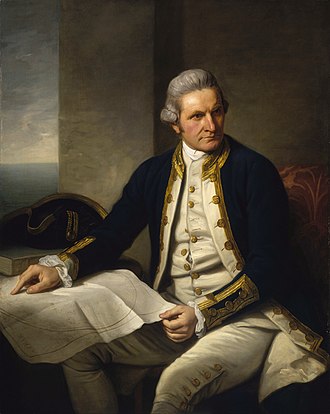
James Cook
Captain James Cook was a British Royal Navy officer, explorer, and cartographer who led three important voyages of exploration to the Pacific and Southern Oceans between 1768 and 1779. He completed the first recorded circumnavigation of the main islands of New Zealand, and was the first European to visit the east coast of Australia and the Hawaiian Islands.
Second voyage of James Cook
The second voyage of James Cook, from 1772 to 1775, commissioned by the British government with advice from the Royal Society, was designed to circumnavigate the globe as far south as possible to finally determine whether there was any great southern landmass, or Terra Australis. On his first voyage, Cook had demonstrated by circumnavigating New Zealand that it was not attached to a larger landmass to the south, and he charted almost the entire eastern coastline of mainland Australia, yet Terra Australis was believed to lie further south. Alexander Dalrymple and others of the Royal Society still believed that this massive southern continent should exist. After a delay brought about by the botanist Joseph Banks' ship modification requests, the ships Resolution and Adventure were fitted for the voyage and set sail for the Antarctic in July 1772.
HMS Resolution (1771)
HMS Resolution was a sloop of the Royal Navy, a converted merchant collier purchased by the Navy and adapted, in which Captain James Cook made his second and third voyages of exploration in the Pacific. She impressed him enough that he called her "the ship of my choice", and "the fittest for service of any I have seen".
Antarctic Circle
The Antarctic Circle is the most southerly of the five major circles of latitude that mark maps of Earth. The region south of this circle is known as the Antarctic, and the zone immediately to the north is called the Southern Temperate Zone. South of the Antarctic Circle, the Sun is above the horizon for 24 continuous hours at least once per year and the centre of the Sun is below the horizon for 24 continuous hours at least once per year ; this is also true within the Arctic Circle, the Antarctic Circle’s counterpart in the Northern Hemisphere.