Eighty Years' War and Anglo-Spanish War: The Battle of Gembloux is a victory for Spanish forces led by Don John of Austria over a rebel army of Dutch, Flemish, English, Scottish, German, French and Walloons.
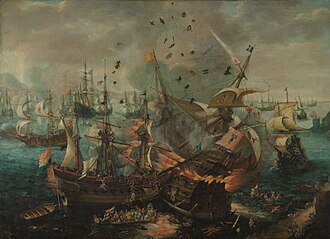
Eighty Years' War
The Eighty Years' War or Dutch Revolt was an armed conflict in the Habsburg Netherlands between disparate groups of rebels and the Spanish government. The causes of the war included the Reformation, centralisation, excessive taxation, and the rights and privileges of the Dutch nobility and cities.
Anglo-Spanish War (1585–1604)
The Anglo-Spanish War (1585–1604) was an intermittent conflict between the Habsburg Kingdom of Spain and the Kingdom of England that was never formally declared. It began with England's military expedition in 1585 to what was then the Spanish Netherlands under the command of Robert Dudley, Earl of Leicester, in support of the Dutch rebellion against Spanish Habsburg rule.
Battle of Gembloux (1578)
The Battle of Gembloux took place at Gembloux, near Namur, Low Countries, between the Spanish forces led by Don John of Austria, Governor-General of the Spanish Netherlands, and a rebel army composed of Dutch, Flemish, English, Scottish, German, French, and Walloon soldiers under Antoine de Goignies, during the Eighty Years' War.
John of Austria
John of Austria was the illegitimate son of Charles V, Holy Roman Emperor. Charles V recognized him in a codicil to his will. John became a military leader in the service of his half-brother, King Philip II of Spain, Charles V's heir, and was addressed to as a Don. He is best known for his role as the admiral of the Holy League fleet at the Battle of Lepanto and as Governor of the Spanish Netherlands.
Dutch people
The Dutch, or Netherlanders are an ethnic group native to the Netherlands. They share a common ancestry and culture and speak the Dutch language. Dutch people and their descendants are found in migrant communities worldwide, notably in Argentina, Aruba, Australia, Brazil, Canada, Caribbean Netherlands, Curaçao, Germany, Guyana, Indonesia, New Zealand, Sint Maarten, South Africa, Suriname, and the United States. The Low Countries were situated around the border of France and the Holy Roman Empire, forming a part of their respective peripheries and the various territories of which they consisted had become virtually autonomous by the 13th century. Under the Habsburgs, the Netherlands were organised into a single administrative unit, and in the 16th and 17th centuries the Northern Netherlands gained independence from Spain as the Dutch Republic. The high degree of urbanisation characteristic of Dutch society was attained at a relatively early date. During the Republic the first series of large-scale Dutch migrations outside of Europe took place.