US Army private Eddie Slovik is executed for desertion, the first such execution of an American soldier since the Civil War.
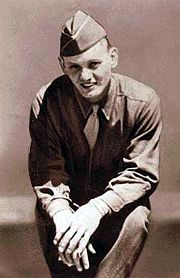
Eddie Slovik
Private Edward Donald Slovik was an American soldier who was court-martialed and executed for desertion during World War II. He was the first and only US serviceman to have met such a fate since the American Civil War, though in 1902, during the American-Philippine War, two American soldiers of the 9th Cavalry Regiment were executed for "desertion to the enemy". Although over 21,000 American servicemen were given varying sentences for desertion during World War II, including 49 death sentences, Slovik's death sentence was the only one that was carried out. The case was brought to public attention by the 1954 book The Execution of Private Slovik by William Bradford Huie, later made into a NBC 1974 television movie.
Capital punishment
Capital punishment, also known as the death penalty and formerly called judicial homicide, is the state-sanctioned killing of a person as punishment for actual or supposed misconduct. The sentence ordering that an offender be punished in such a manner is called a death sentence, and the act of carrying out the sentence is an execution. A prisoner who has been sentenced to death and awaits execution is condemned and is commonly referred to as being "on death row". Etymologically, the term capital refers to execution by beheading, but executions are carried out by many methods.
Desertion
Desertion is the abandonment of a military duty or post without permission and is done with the intention of not returning. This contrasts with unauthorized absence (UA) or absence without leave, which are temporary forms of absence.
American Civil War
The American Civil War was a civil war in the United States between the Union and the Confederacy, which was formed in 1861 by states that had seceded from the Union. The central conflict leading to war was a dispute over whether slavery should be permitted to expand into the western territories, leading to more slave states, or be prohibited from doing so, which many believed would place slavery on a course of ultimate extinction.