Ottoman wars in Europe: Siege of Belgrade: John Hunyadi, Regent of the Kingdom of Hungary, defeats Mehmet II of the Ottoman Empire.
Ottoman wars in Europe
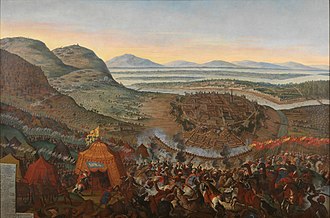
A series of military conflicts between the Ottoman Empire and various European states took place from the Late Middle Ages up through the early 20th century. The earliest conflicts began during the Byzantine–Ottoman wars, waged in Anatolia in the late 13th century before entering Europe in the mid-14th century with the Bulgarian–Ottoman wars. The mid-15th century saw the Serbian–Ottoman wars and the Albanian-Ottoman wars. Much of this period was characterized by the Ottoman expansion into the Balkans. The Ottoman Empire made further inroads into Central Europe in the 15th and 16th centuries, culminating in the peak of Ottoman territorial claims in Europe.
Siege of Belgrade (1456)
The siege of Belgrade, or siege of Nándorfehérvár was a military blockade of Belgrade that occurred 4–22 July 1456 in the aftermath of the fall of Constantinople in 1453 marking the Ottomans' attempts to expand further into Europe. Led by Sultan Mehmed II, the Ottoman forces sought to capture the strategic city of Belgrade, which was then under Hungarian control and was crucial for maintaining control over the Danube River and the Balkans.
John Hunyadi
John Hunyadi was a leading Hungarian military and political figure during the 15th century, who served as regent of the Kingdom of Hungary from 1446 to 1453, under the minor Ladislaus V.
Kingdom of Hungary
The Kingdom of Hungary was a monarchy in Central Europe that existed for nearly a millennium, from 1000 to 1946 and was a key part of the Habsburg monarchy from 1526-1918. The Catholic kingdom emerged as a continuation of the Grand Principality of Hungary upon the coronation of the first king Stephen I at Esztergom around the year 1000; his family led the monarchy for 300 years. By the 12th century, the kingdom had become a European power.