events
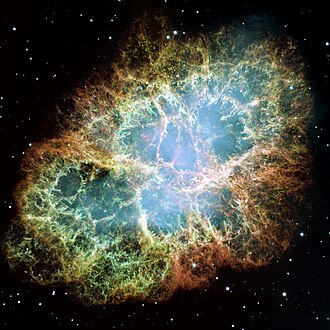
A supernova, called SN 1054, is seen by Chinese Song dynasty, Arab, and possibly Amerindian observers near the star Zeta Tauri. For several months it remains bright enough to be seen during the day. Its remnants form the Crab Nebula.
Related Wikipedia articles
SN 1054
Supernova in the constellation Taurus; visible from 1054 to 1056
SN 1054, the Crab Supernova, is a supernova that was first observed on c. 10 July [O.S. c. 4 July] 1054, and remained visible until c. 12 April [O.S. c. 6 April] 1056.αSource: Wikipedia (CC BY-SA)
Song dynasty
Chinese imperial dynasty from 960 to 1279
The Song dynasty was an imperial dynasty of China that ruled from 960 to 1279. The dynasty was founded by Emperor Taizu of Song, who usurped the throne of the Later Zhou dynasty and went on to conquer the rest of the Ten Kingdoms, ending the Five Dynasties and Ten Kingdoms…Source: Wikipedia (CC BY-SA)
Arabs
Ethnic group
Arabs are an ethnic group mainly inhabiting the Arab world in West Asia and North Africa. A significant Arab diaspora is present in various parts of the world.Source: Wikipedia (CC BY-SA)
Indigenous peoples of the Americas
The Indigenous peoples of the Americas are the peoples who are native to the Americas or the Western Hemisphere. Their ancestors are among the pre-Columbian population of South or North America, including Central America and the Caribbean. Indigenous peoples live throughout the…Source: Wikipedia (CC BY-SA)
Zeta Tauri
Binary star in the constellation Taurus
Zeta Tauri is a binary star in the zodiac constellation of Taurus, the Bull. It has an apparent visual magnitude of about 3.0, which is bright enough to be seen with the naked eye. Parallax measurements place it at a distance of roughly 440 light-years from the Sun. The position…Source: Wikipedia (CC BY-SA)
Crab Nebula
Supernova remnant in the constellation Taurus
The Crab Nebula is a supernova remnant and pulsar wind nebula in the constellation of Taurus. The common name comes from a drawing that somewhat resembled a crab with arms produced by William Parsons, 3rd Earl of Rosse, in 1842 or 1843 using a 36-inch (91 cm) telescope. The…Source: Wikipedia (CC BY-SA)