Argentina declares independence from Spain.
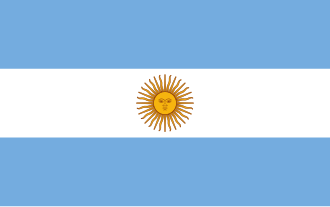
Argentina
Argentina, officially the Argentine Republic, is a country in the southern half of South America. It covers an area of 2,780,085 km2 (1,073,397 sq mi), making it the second-largest country in South America after Brazil, the fourth-largest country in the Americas, and the eighth-largest country in the world. Argentina shares the bulk of the Southern Cone with Chile to the west, and is also bordered by Bolivia and Paraguay to the north, Brazil to the northeast, Uruguay and the South Atlantic Ocean to the east, and the Drake Passage to the south. Argentina is a federal state subdivided into twenty-three provinces, and one autonomous city, which is the federal capital and largest city of the nation, Buenos Aires. The provinces and the capital have their own constitutions, but exist under a federal system. Argentina claims sovereignty over the Falkland Islands, South Georgia and the South Sandwich Islands, the Southern Patagonian Ice Field, and a part of Antarctica.
Argentine Declaration of Independence
The Independence of the Argentine Republic was declared on July 9, 1816, by the Congress of Tucumán. In reality, the congressmen who were assembled in Tucumán declared the independence of the United Provinces of South America, which is one of the official names of the Argentine Republic. The Federal League Provinces, at war with the United Provinces, were not allowed into the Congress. At the same time, several provinces from the Upper Peru that would later become part of present-day Bolivia, were represented at the Congress.