Cassini–Huygens makes its closest flyby of the Saturn moon Phoebe.
Cassini–Huygens
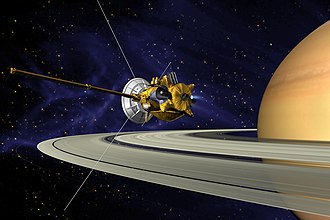
Cassini–Huygens, commonly called Cassini, was a space-research mission by NASA, the European Space Agency (ESA), and the Italian Space Agency (ASI) to send a space probe to study the planet Saturn and its system, including its rings and natural satellites. The Flagship-class robotic spacecraft comprised both NASA's Cassini space probe and ESA's Huygens lander, which landed on Saturn's largest moon, Titan. Cassini was the fourth space probe to visit Saturn and the first to enter its orbit, where it stayed from 2004 to 2017. The two craft took their names from the astronomers Giovanni Cassini and Christiaan Huygens.
Saturn
Saturn is the sixth planet from the Sun and the second largest in the Solar System, after Jupiter. It is a gas giant, with an average radius of about 9 times that of Earth. It has an eighth the average density of Earth, but is over 95 times more massive. Even though Saturn is almost as big as Jupiter, Saturn has less than a third its mass. Saturn orbits the Sun at a distance of 9.59 AU (1,434 million km), with an orbital period of 29.45 years.
Natural satellite
A natural satellite is, in the most common usage, an astronomical body that orbits a planet, dwarf planet, or small Solar System body. Natural satellites are colloquially referred to as moons, a derivation from the Moon of Earth.
Phoebe (moon)
Phoebe is the most massive irregular satellite of Saturn with a mean diameter of 213 km (132 mi). It was discovered by William Henry Pickering on 18 March 1899 from photographic plates that had been taken by DeLisle Stewart starting on 16 August 1898 at the Boyden Station of the Carmen Alto Observatory near Arequipa, Peru. It was the first natural satellite to be discovered photographically.