Guglielmo Marconi applies for a patent for his wireless telegraph.
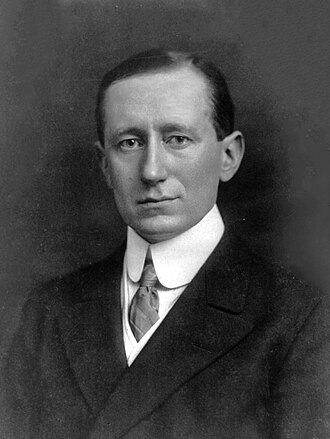
Guglielmo Marconi
Guglielmo Giovanni Maria Marconi, 1st Marquess of Marconi was an Italian electrical engineer, inventor, and politician known for his creation of a practical radio wave-based wireless telegraph system. This led to Marconi being largely credited as the inventor of radio and sharing the 1909 Nobel Prize in Physics with Karl Ferdinand Braun "in recognition of their contributions to the development of wireless telegraphy". His work laid the foundation for the development of radio, television, and all modern wireless communication systems.
Patent
A patent is a type of intellectual property that gives its owner the legal right to exclude others from making, using, or selling an invention for a limited period of time in exchange for publishing an enabling disclosure of the invention. In most countries, patent rights fall under private law and the patent holder must sue someone infringing the patent in order to enforce their rights.
Wireless telegraphy
Wireless telegraphy or radiotelegraphy is the transmission of text messages by radio waves, analogous to electrical telegraphy using cables. Before about 1910, the term wireless telegraphy was also used for other experimental technologies for transmitting telegraph signals without wires. In radiotelegraphy, information is transmitted by pulses of radio waves of two different lengths called "dots" and "dashes", which spell out text messages, usually in Morse code. In a manual system, the sending operator taps on a switch called a telegraph key which turns the transmitter on and off, producing the pulses of radio waves. At the receiver the pulses are audible in the receiver's speaker as beeps, which are translated back to text by an operator who knows Morse code.