births
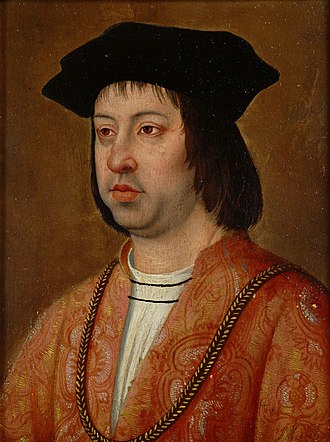
Ferdinand II, also known as Ferdinand I, Ferdinand III, and Ferdinand V, called Ferdinand the Catholic, was King of Aragon from 1479 until his death in 1516. As the husband and co-ruler of Queen Isabella I of Castile, he was also King of Castile from 1475 to 1504. He reigned jointly with Isabella over a dynastically unified Spain; together they are known as the Catholic Monarchs. Ferdinand is considered the de facto first king of Spain, and was described as such during his reign, even though, legally, Castile and Aragon remained two separate kingdoms until they were formally united by the Nueva Planta decrees issued between 1707 and 1716.
The Kingdom of Castile was a polity in the Iberian Peninsula during the Middle Ages. It traces its origins to the 9th-century County of Castile, as an eastern frontier lordship of the Kingdom of León. During the 10th century, the Castilian counts increased their autonomy, but it was not until 1065 that it was separated from the Kingdom of León and became a kingdom in its own right. Between 1072 and 1157, it was again united with León, and after 1230, the union became permanent.
The Kingdom of León was an independent kingdom situated in the northwest region of the Iberian Peninsula. It was founded in 910 when the Christian princes of Asturias along the northern coast of the peninsula shifted their capital from Oviedo to the city of León. The kings of León fought civil wars, wars against neighbouring kingdoms, and campaigns to repel invasions by both the Moors and the Vikings, all in order to protect their kingdom's changing fortunes.
March 10 is the 69th day of the year in the Gregorian calendar; 296 days remain until the end of the year.