Admiral Sir John Byng is executed by firing squad aboard HMS Monarch for breach of the Articles of War.
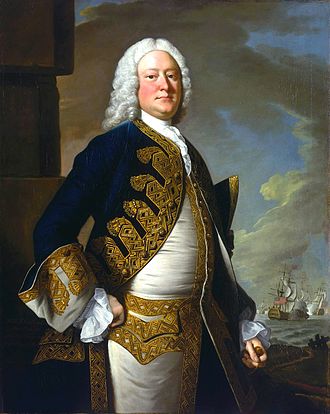
John Byng
Admiral John Byng was a Royal Navy officer and a politician. Joining the Navy at thirteen, he would participate in battles, such as the Battle of Cape Passaro, and gain a reputation as a solid officer—eventually, a vice-admiral. Amidst his naval career, he served as Commodore-Governor of Newfoundland Colony in 1742, and the Commander-in-Chief, Leith, from 1745 to 1746, and he was a member of Parliament from 1751 to his death.
Execution by firing squad
Execution by firing squad, in the past sometimes called fusillading, is a method of capital punishment, particularly common in the military and in times of war. Some reasons for its use are that firearms are usually readily available and a gunshot to a vital organ, such as the brain or heart, most often will kill relatively quickly.
HMS Monarch (1747)
HMS Monarch was originally the 74-gun ship of the line Monarque of the French Navy launched in March 1747. Captured on 14 October 1747, she was taken into Royal Navy service as the third rate HMS Monarch.
Articles of War
The Articles of War are a set of regulations drawn up to govern the conduct of a country's military and naval forces. The first known usage of the phrase is in Robert Monro's 1637 work His expedition with the worthy Scot's regiment called Mac-keyes regiment etc. and can be used to refer to military law in general. In Swedish, the equivalent term Krigsartiklar, is first mentioned in 1556. However, the term is usually used more specifically and with the modern spelling and capitalisation to refer to the British regulations drawn up in the wake of the Glorious Revolution and the United States regulations later based on them.