Mystic Phan Xích Long, the self-proclaimed Emperor of Vietnam, is arrested for organising a revolt against the colonial rule of French Indochina, which was nevertheless carried out by his supporters the following day.
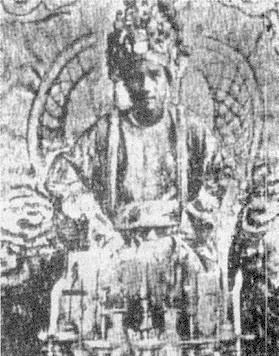
Phan Xích Long
Phan Xích Long, also known as Hồng Long, born Phan Phát Sanh, was a Vietnamese mystic and geomancer who raised an unsuccessful uprising against French rule in Cochinchina from 1913 to 1916. He attempted to exploit religion as a cover for his own political ambitions, having started his own ostensibly religious organisation. Claiming to be a descendant of Emperor Hàm Nghi, Long staged a ceremony to crown himself as the emperor of Vietnam, before trying to seize power in 1913 by launching an armed uprising against the colonial rule of French Indochina. His supporters launched an attack on Saigon in March 1913, drinking potions that purportedly made them invisible and planting bombs at several locations. The insurrection against the French colonial administration failed when none of the bombs detonated and the supposedly invisible supporters were apprehended.
List of monarchs of Vietnam
This article lists the monarchs of Vietnam. Under the emperor at home, king abroad system used by later dynasties, Vietnamese monarchs would use the title of emperor domestically, and the more common term sovereign, king, or his/her (Imperial) Majesty elsewhere.
French Indochina
French Indochina, officially known as the Indochinese Union and after 1941 as the Indochinese Federation, was a group of French dependent territories in Southeast Asia from 1887 to 1954. It was initially a federation of French colonies (1887–1949), later a confederation of French associated states (1949–1954). It comprised Cambodia, Laos, Guangzhouwan (1898–1945), Cochinchina, and Vietnamese regions of Tonkin and Annam. It was established in 1887 and was dissolved in 1954. In 1949, Vietnam was reunited and it regained Cochinchina. Its capitals were Hanoi (1902–1945) and Saigon.
March 22
March 22 is the 81st day of the year in the Gregorian calendar; 284 days remain until the end of the year.