German physician Robert Koch announced the discovery of Mycobacterium tuberculosis, the pathogen that causes tuberculosis.
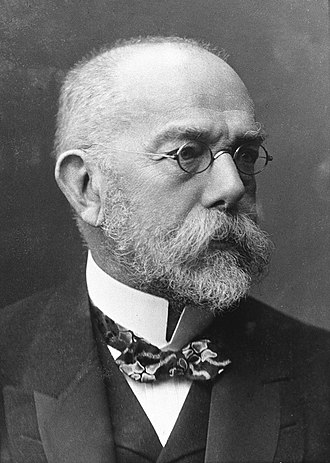
Robert Koch
Heinrich Hermann Robert Koch was a German physician and microbiologist. As the discoverer of the specific causative agents of deadly infectious diseases including tuberculosis, cholera and anthrax, he is regarded as one of the main founders of modern bacteriology. As such he is popularly nicknamed the father of microbiology, and as the father of medical bacteriology. His discovery of the anthrax bacterium in 1876 is considered as the birth of modern bacteriology. Koch used his discoveries to establish that germs "could cause a specific disease" and directly provided proofs for the germ theory of diseases, therefore creating the scientific basis of public health, saving millions of lives. For his life's work Koch is seen as one of the founders of modern medicine.
Mycobacterium tuberculosis
Mycobacterium tuberculosis, also known as Koch's bacillus, is a species of pathogenic bacteria in the family Mycobacteriaceae and the causative agent of tuberculosis.
Pathogen
In biology, a pathogen, in the oldest and broadest sense, is any organism or agent that can produce disease. A pathogen may also be referred to as an infectious agent, or simply a germ.
Tuberculosis
Tuberculosis (TB), also known colloquially as the "white death", or historically as consumption, is a contagious disease usually caused by Mycobacterium tuberculosis (MTB) bacteria. Tuberculosis generally affects the lungs, but it can also affect other parts of the body. Most infections show no symptoms, in which case it is known as inactive or latent tuberculosis. A small proportion of latent infections progress to active disease that, if left untreated, can be fatal. Typical symptoms of active TB are chronic cough with blood-containing mucus, fever, night sweats, and weight loss. Infection of other organs can cause a wide range of symptoms.