Ferdinand Magellan and members of his crew participated in the first Catholic Mass in the Philippines.
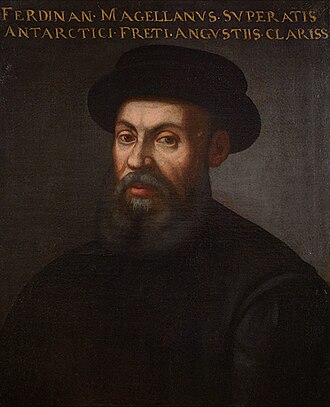
Ferdinand Magellan
Ferdinand Magellan was a Portuguese explorer best known for having planned and led the 1519–22 Spanish expedition to the East Indies. During this expedition, he also discovered the Strait of Magellan, allowing his fleet to pass from the Atlantic into the Pacific Ocean and perform the first European navigation to Asia via the Pacific. Magellan was killed in battle in the Philippines and his crew, commanded by the Spanish Juan Sebastián Elcano, completed the return trip to Spain in 1522 achieving the first circumnavigation of Earth in history.
Magellan expedition
The Magellan expedition, sometimes termed the Magellan–Elcano expedition, was a 16th-century Spanish expedition planned and led by Portuguese explorer Ferdinand Magellan. One of the most important voyages in the Age of Discovery, its purpose was to secure a maritime trade route with the Moluccas, or Spice Islands, in present-day Indonesia. The expedition departed Spain in 1519 and returned there in 1522 led by Spanish navigator Juan Sebastián Elcano, who crossed the Indian Ocean after Magellan's death in the Philippines. Totaling 60,440 km, or 37,560 mi, the nearly three-year voyage achieved the first circumnavigation of Earth in history. It also marked the first crossing of the Pacific by a European expedition, revealing the vast scale of that ocean, and proved that ships could sail around the world on a western sea route.
First Mass in the Philippines
The first documented Catholic Mass in the Philippines was held on March 31, 1521, Easter Sunday. It was conducted by Father Pedro de Valderrama of Ferdinand Magellan's expedition along the shores of what was referred to in the journals of Antonio Pigafetta as "Mazaua".