International Women's Day protests in Petrograd mark the beginning of the February Revolution (February 23 in the Julian calendar).
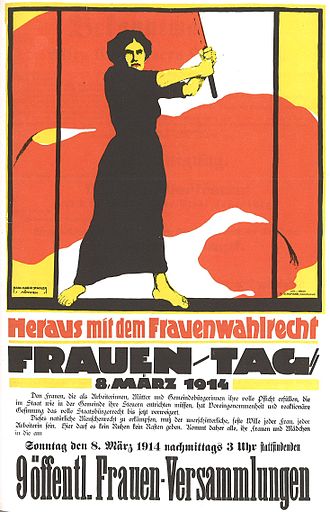
International Women's Day
International Women's Day (IWD) is celebrated on 8 March, commemorating women's fight for equality and liberation along with the women's rights movement. International Women's Day gives focus to issues such as gender equality, reproductive rights, and violence and abuse against women. Spurred by the universal female suffrage movement, International Women's Day originated from labor movements in Europe and North America during the early 20th century.
Saint Petersburg
Saint Petersburg, formerly known as Petrograd and later Leningrad, is the second-largest city in Russia after Moscow. It is situated on the River Neva, at the head of the Gulf of Finland on the Baltic Sea. With an area of 1,439 sq km, Saint Petersburg is the smallest administrative division of Russia by area. The city had a population of 5,601,911 residents as of 2021, with more than 6.4 million people living in the metropolitan area. Saint Petersburg is the fourth-most populous city in Europe, the most populous city on the Baltic Sea, and the world's northernmost city of more than 1 million residents. As the former capital of the Russian Empire, and a historically strategic port, it is governed as a federal city.
February Revolution
The February Revolution, known in Soviet historiography as the February Bourgeois Democratic Revolution, and sometimes as the March Revolution or February Coup, was the first of two revolutions which took place in Russia in 1917.
Julian calendar
The Julian calendar is a solar calendar of 365 days in every year with an additional leap day every fourth year. The Julian calendar is still used as a religious calendar in parts of the Eastern Orthodox Church and in parts of Oriental Orthodoxy as well as by the Amazigh people. For a quick calculation, between 1901 and 2099 the much more common Gregorian date equals the Julian date plus 13 days.