The first documented discovery of gold in California occurs at Rancho San Francisco, six years before the California Gold Rush.
Gold
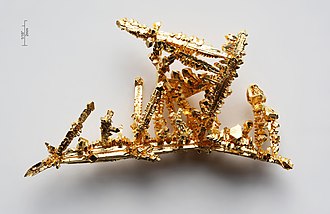
Gold is a chemical element; it has chemical symbol Au and atomic number 79. In its pure form, it is a bright, slightly orange-yellow, dense, soft, malleable, and ductile metal. Chemically, gold is a transition metal, a group 11 element, and one of the noble metals. It is one of the least reactive chemical elements, being the second lowest in the reactivity series, with only platinum ranked as less reactive. Gold is solid under standard conditions.
California
California is a state in the Western United States that lies on the Pacific Coast. It borders Oregon to the north, Nevada and Arizona to the east, and shares an international border with the Mexican state of Baja California to the south. With almost 40 million residents across an area of 163,696 square miles (423,970 km2), it is the largest state by population and third-largest by area.
Rancho San Francisco
Rancho San Francisco was a land grant in present-day northwestern Los Angeles County and eastern Ventura County, California. It was a grant of 48,612 acres (19,673 ha) by Governor Juan B. Alvarado to Antonio del Valle, a Mexican army officer, in recognition for his service to Alta California. It is not related to the city of San Francisco.
California gold rush
The California gold rush (1848–1855) began on January 24, 1848, when gold was found by James W. Marshall at Sutter's Mill in Coloma, California. The news of gold brought approximately 300,000 people to California from the rest of the United States and abroad. The sudden influx of gold into the money supply reinvigorated the American economy; the sudden population increase allowed California to grow rapidly into statehood in the Compromise of 1850. The gold rush had severe effects on Native Californians and accelerated the Native American population's decline from disease, starvation, and the California genocide.