Venera program: Venera 5, a Soviet space probe, lands on Venus.
Venera
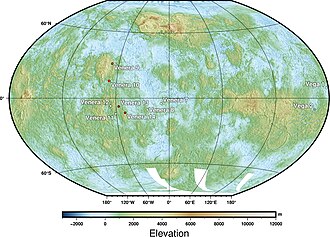
The Venera program was a series of space probes developed by the Soviet Union between 1961 and 1984 to gather information about the planet Venus.
Venera 5
Venera 5 was a space probe in the Soviet space program Venera for the exploration of Venus.
Uncrewed spacecraft
Uncrewed spacecraft or robotic spacecraft are spacecraft without people on board. Uncrewed spacecraft may have varying levels of autonomy from human input, such as remote control, or remote guidance. They may also be autonomous, in which they have a pre-programmed list of operations that will be executed unless otherwise instructed. A robotic spacecraft for scientific measurements is often called a space probe or space observatory.
Venus
Venus is the second planet from the Sun. It is often called Earth's "twin" or "sister" among the planets of the Solar System for its orbit being the closest to Earth's, both being rocky planets and having the most similar and nearly equal size and mass. Venus, though, differs significantly by having no liquid water, and its atmosphere is far thicker and denser than that of any other rocky body in the Solar System. It is composed of mostly carbon dioxide and has a cloud layer of sulfuric acid that spans the whole planet. At the mean surface level, the atmosphere reaches a temperature of 737 K and a pressure 92 times greater than Earth's at sea level, turning the lowest layer of the atmosphere into a supercritical fluid. From Earth Venus is visible as a star-like point of light, appearing brighter than any other natural point of light in Earth's sky, and as an inferior planet always relatively close to the Sun, either as the brightest "morning star" or "evening star".