Pope Gregory XI issues five papal bulls to denounce the doctrines of English theologian John Wycliffe.
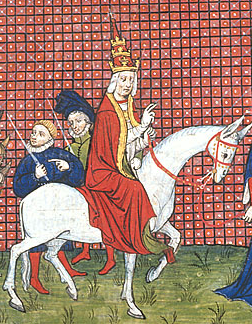
Pope Gregory XI
Pope Gregory XI was head of the Catholic Church from 30 December 1370 to his death, in March 1378. He was the seventh and last Avignon pope and the most recent French pope. In 1377, Gregory XI returned the papal court to Rome, ending nearly 70 years of papal residency in Avignon, in modern-day France. His death was swiftly followed by the Western Schism involving two Avignon-based antipopes.
Papal bull
A papal bull is a type of public decree, letters patent, or charter issued by the pope of the Catholic Church. It is named after the leaden seal (bulla) traditionally appended to authenticate it.
Doctrine
Doctrine is a codification of beliefs or a body of teachings or instructions, taught principles or positions, as the essence of teachings in a given branch of knowledge or in a belief system. The etymological Greek analogue is 'catechism'.
Theology
Theology is the study of religious belief from a religious perspective, with a focus on the nature of divinity and the history behind religion. It is taught as an academic discipline, typically in universities and seminaries. It occupies itself with the unique content of analyzing the supernatural, but also deals with religious epistemology, asks and seeks to answer the question of revelation. Revelation pertains to the acceptance of God, gods, or deities, as not only transcendent or above the natural world, but also willing and able to interact with the natural world and to reveal themselves to humankind.
John Wycliffe
John Wycliffe was an English scholastic philosopher, Christian reformer, Catholic priest, and a theology professor at the University of Oxford. Wycliffe is traditionally believed to have advocated for or made a vernacular translation of the Vulgate Bible into Middle English, though more recent scholarship has minimised the extent of his advocacy or involvement for lack of direct contemporary evidence.