Servius Tullius, the king of Rome, celebrates a triumph for his victory over the Etruscans.
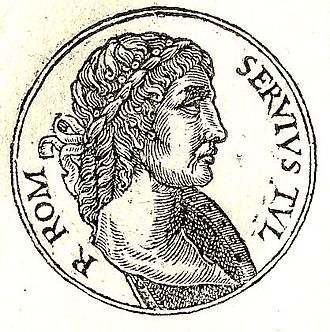
Servius Tullius
Servius Tullius was the legendary sixth king of Rome, and the second of its Etruscan dynasty. He reigned from 578 to 535 BC. Roman and Greek sources describe his servile origins and later marriage to a daughter of Lucius Tarquinius Priscus, Rome's first Etruscan king, who was assassinated in 579 BC. The constitutional basis for his accession is unclear; he is variously described as the first Roman king to accede without election by the Senate, having gained the throne by popular and royal support; and as the first to be elected by the Senate alone, with support of the reigning queen but without recourse to a popular vote.
Ancient Rome
In modern historiography, ancient Rome is the Roman civilisation from the founding of the Italian city of Rome in the 8th century BC to the collapse of the Western Roman Empire in the 5th century AD. It encompasses the Roman Kingdom (753–509 BC), the Roman Republic (509–27 BC), and the Roman Empire until the fall of the western empire.
Roman triumph
The Roman triumph was a civil ceremony and religious rite of ancient Rome, held to publicly celebrate and sanctify the success of a military commander who had led Roman forces to victory in the service of the state or, in some historical traditions, one who had successfully completed a foreign war.
Etruscan civilization
The Etruscan civilization was an ancient civilization created by the Etruscans, a people who inhabited Etruria in ancient Italy, with a common language and culture, and formed a federation of city-states. After adjacent lands had been conquered its territory covered, at its greatest extent, roughly what is now Tuscany, western Umbria and northern Lazio, as well as what are now the Po Valley, Emilia-Romagna, south-eastern Lombardy, southern Veneto and western Campania.