Robert Koch, German physician and microbiologist, Nobel Prize laureate (born 1843)
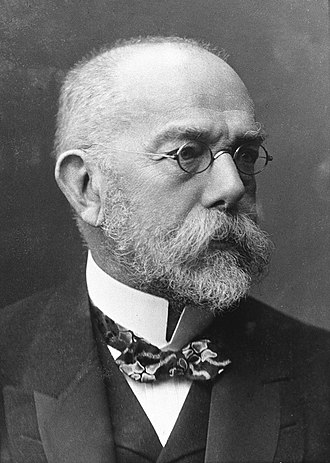
Robert Koch
Heinrich Hermann Robert Koch was a German physician and microbiologist. As the discoverer of the specific causative agents of deadly infectious diseases including tuberculosis, cholera and anthrax, he is regarded as one of the main founders of modern bacteriology. As such he is popularly nicknamed the father of microbiology, and as the father of medical bacteriology. His discovery of the anthrax bacterium in 1876 is considered as the birth of modern bacteriology. Koch used his discoveries to establish that germs "could cause a specific disease" and directly provided proofs for the germ theory of diseases, therefore creating the scientific basis of public health, saving millions of lives. For his life's work Koch is seen as one of the founders of modern medicine.
Nobel Prize in Physiology or Medicine
The Nobel Prize in Physiology or Medicine is awarded yearly by the Nobel Assembly at the Karolinska Institute for outstanding discoveries in physiology or medicine. The Nobel Prize is not a single prize, but five separate prizes that, according to Alfred Nobel's 1895 will, are awarded "to those who, during the preceding year, have conferred the greatest benefit to humankind". Nobel Prizes are awarded in the fields of Physics, Medicine or Physiology, Chemistry, Literature, and Peace.