Andrew Huxley, English physiologist and biophysicist, Nobel Prize laureate (born 1917)
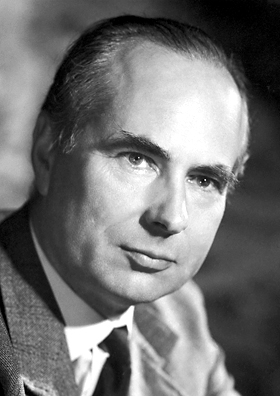
Andrew Huxley
Sir Andrew Fielding Huxley was an English physiologist and biophysicist. He was born into the prominent Huxley family. After leaving Westminster School in central London, he went to Trinity College, Cambridge, on a scholarship, after which he joined Alan Hodgkin to study nerve impulses. Their eventual discovery of the basis for propagation of nerve impulses earned them the Nobel Prize in Physiology or Medicine in 1963. They made their discovery from the giant axon of the Atlantic squid. Soon after the outbreak of the Second World War, Huxley was recruited by the British Anti-Aircraft Command and later transferred to the Admiralty. After the war he resumed research at the University of Cambridge, where he developed interference microscopy that would be suitable for studying muscle fibres.
Nobel Prize in Physiology or Medicine
The Nobel Prize in Physiology or Medicine is awarded yearly by the Nobel Assembly at the Karolinska Institute for outstanding discoveries in physiology or medicine. The Nobel Prize is not a single prize, but five separate prizes that, according to Alfred Nobel's 1895 will, are awarded "to those who, during the preceding year, have conferred the greatest benefit to humankind". Nobel Prizes are awarded in the fields of Physics, Medicine or Physiology, Chemistry, Literature, and Peace.