In the papal bull Inter caetera, Pope Alexander VI divides the New World between Spain and Portugal along the Line of Demarcation.
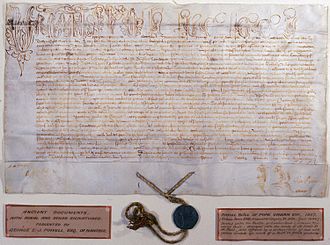
Papal bull
A papal bull is a type of public decree, letters patent, or charter issued by the pope of the Catholic Church. It is named after the leaden seal (bulla) traditionally appended to authenticate it.
Inter caetera
Inter caetera was a papal bull issued by Pope Alexander VI on 4 May 1493, which granted to the Catholic Monarchs King Ferdinand II of Aragon and Queen Isabella I of Castile all lands to the "west and south" of a pole-to-pole line 100 leagues west and south of any of the islands of the Azores or the Cape Verde islands.
Pope Alexander VI
Pope Alexander VI was head of the Catholic Church and ruler of the Papal States from 11 August 1492 until his death in 1503.
New World
The "New World" is a eurocentric term used to describe the majority of lands of Earth's Western Hemisphere, particularly the Americas, and sometimes Oceania. The term arose in the early 16th century during Europe's colonization period, after Italian explorer Amerigo Vespucci published the Latin-language pamphlet Mundus Novus, presenting his conclusion that the lands to the west of the Atlantic Ocean constitute new continents.
Treaty of Tordesillas
The Treaty of Tordesillas, signed in Tordesillas, Spain, on 7 June 1494, and ratified in Setúbal, Portugal, divided the newly discovered lands outside Europe between the Kingdom of Portugal and the Crown of Castile, along a meridian 370 leagues or 2,100 kilometres (1,300 mi) west of the Cape Verde islands, off the west coast of Africa. That line of demarcation was about halfway between Cape Verde and the islands visited by Christopher Columbus on his first voyage, named in the treaty as Cipangu and Antillia.