The signing of the Bishkek Protocol between Armenia and Azerbaijan effectively freezes the Nagorno-Karabakh conflict.
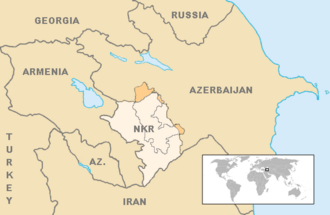
Bishkek Protocol
The Bishkek Protocol was a provisional ceasefire agreement, signed by the representatives of Armenia, Azerbaijan, the unrecognized Republic of Artsakh, and Russia on May 12, 1994, in Bishkek, the capital of Kyrgyzstan.
Armenia
Armenia, officially the Republic of Armenia, is a landlocked country in the Armenian highlands of West Asia. It is a part of the Caucasus region and is bordered by Turkey to the west, Georgia to the north and Azerbaijan to the east, and Iran and the Azerbaijani exclave Nakhchivan to the south. Yerevan is the capital, largest city and financial center.
Azerbaijan
Azerbaijan, officially the Republic of Azerbaijan, is a transcontinental and landlocked country at the boundary of West Asia and Eastern Europe. It is a part of the South Caucasus region and is bounded by the Caspian Sea to the east, Russia's republic of Dagestan to the north, Georgia to the northwest, Armenia and Turkey to the west, and Iran to the south. Baku is the capital and largest city.
Nagorno-Karabakh conflict
The Nagorno-Karabakh conflict was an ethnic and territorial conflict between Armenia and Azerbaijan over the region of Nagorno-Karabakh, inhabited mostly by ethnic Armenians until 2023, and seven surrounding districts, inhabited mostly by Azerbaijanis until their expulsion during the 1990s. The Nagorno-Karabakh region was entirely claimed by and partially controlled by the breakaway Republic of Artsakh, but was recognized internationally as part of Azerbaijan. Azerbaijan gradually re-established control over Nagorno-Karabakh region and the seven surrounding districts.